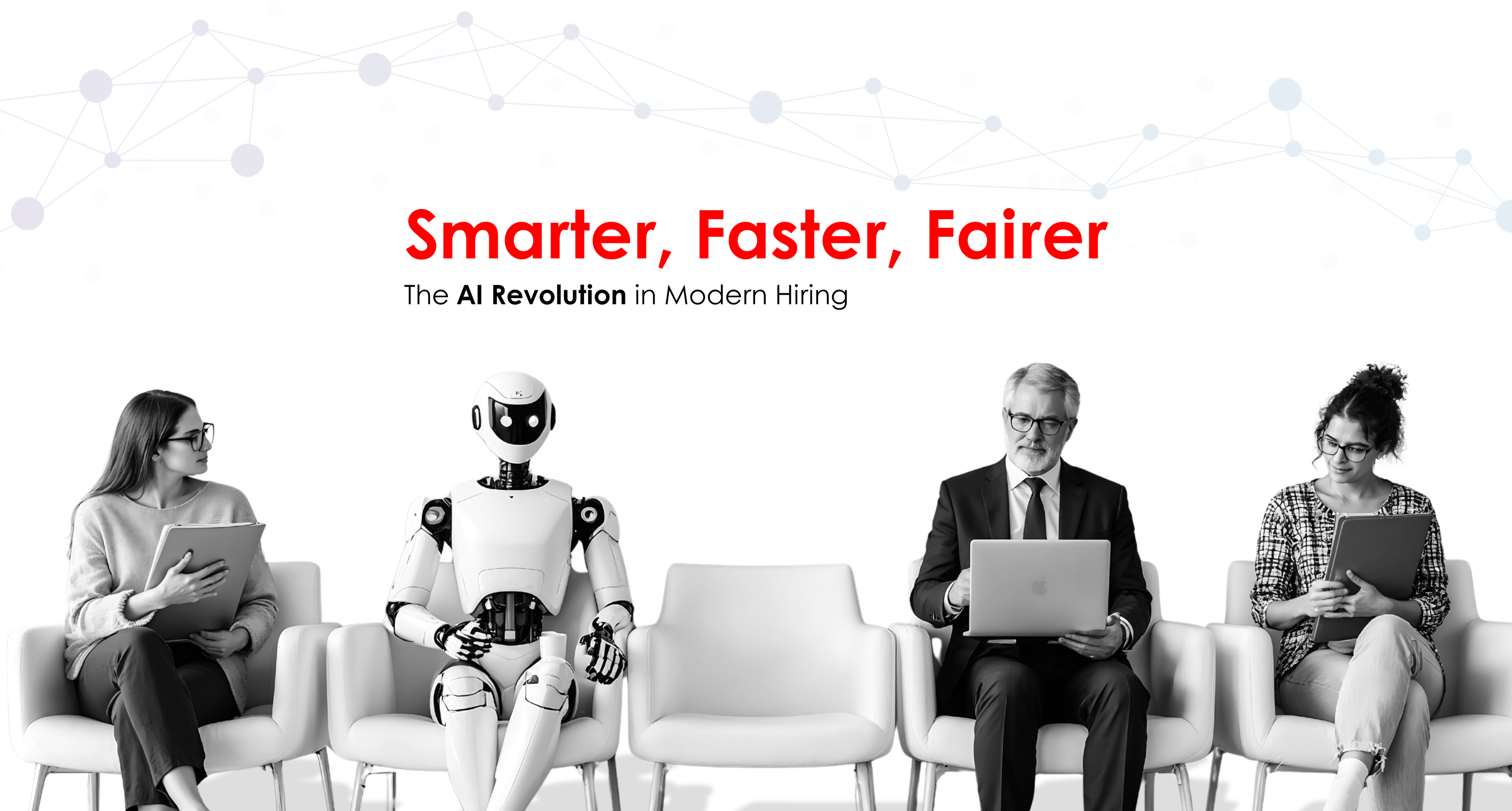
Smarter, Faster, Fairer- The AI revolution in Modern Hiring
Remember the days when hiring meant drowning in a sea of résumés, endless phone calls, and long gaps between interviews? Those days aren’t coming back.
Hiring still matters just as much—but the process looks completely different now. AI-driven talent acquisition isn’t some distant future idea. It’s already here, reshaping how companies attract, evaluate, and retain top talent.
Automation brings order to the old chaos. It saves time, reduces bias, and helps companies uncover great candidates they may have never found otherwise.
The question isn’t whether AI will transform recruiting—it already has. The real question is: how do we use it wisely?
Why Use AI in Recruiting?
Hiring is complex. Posting jobs, screening applications, interviewing, assessing, onboarding—it all consumes massive time and effort.
AI removes friction by replacing slow, manual processes with fast, data-driven decisions.
Here’s what AI is doing right now:
- Scanning thousands of résumés in seconds
- Matching candidates to roles based on skills
- Automating interview scheduling
- Identifying soft skills through behavioral analysis
- Personalizing candidate journeys at scale
Platforms like LinkedIn Talent Insights, Workday Recruiting, and HackerRank are already leading this shift.
AI isn’t here to replace recruiters. It frees them from busywork so they can focus on what matters most—people.
So, What’s Actually Changing?
1. Sourcing: From Cast Nets to Laser Focus
AI doesn’t wait for applications—it actively finds talent.
By scanning professional networks, portfolios, databases, and online profiles, AI identifies qualified candidates before they even apply. This creates deeper, more diverse talent pools.
Need “Java developers with fintech experience”? AI delivers a shortlist in minutes instead of weeks.
2. Resume Screening: No More Manual Sorting
Manual résumé screening is slow and biased. AI uses skill-based logic to evaluate candidates consistently.
It can:
- Identify job-specific skills
- Analyze experience relevance
- Flag gaps or mismatches
- Highlight top candidates objectively
Hiring becomes data-driven instead of guesswork.
3. Interview Automation: Faster and Fairer
Scheduling interviews used to take days. AI handles it instantly.
- Checks calendars automatically
- Sends invites and reminders
- Manages time zones
- Ensures structured, standardized interviews
This creates consistency and fairness across candidates.
4. Predictive Analytics: Hiring for Long-Term Success
AI doesn’t just evaluate candidates—it predicts outcomes.
By analyzing performance data, engagement trends, and retention patterns, AI helps recruiters answer a better question:
Who’s likely to thrive and stay?
This shifts hiring from short-term wins to long-term success.
5. Candidate Experience: A Personal Touch at Scale
Today’s candidates expect transparency, speed, and respect.
AI enhances the experience by:
- Using chatbots to answer questions instantly
- Providing real-time application updates
- Personalizing recommendations
- Making onboarding smooth and welcoming
Candidates feel informed—not ignored.
Where AI Makes the Biggest Impact
- Speed: Hiring cycles drop from months to weeks
- Quality: Better matches, fewer bad hires
- Bias reduction: Skills over background
- Cost efficiency: Lower agency fees and turnover
- Scalability: Hiring 200 feels like hiring 20
The Human Factor: What AI Can’t Replace
AI excels at analysis—but it can’t feel empathy, understand nuance, or assess culture fit.
Great recruiters see the whole person. AI sees patterns.
The real power comes from combining both.
The Risks: Why Responsible AI Matters
AI must be used thoughtfully.
- Algorithms must be monitored for bias
- Candidate data must be protected
- Decisions must remain transparent
- Human accountability is essential
AI is only as fair as the data it learns from. Oversight isn’t optional—it’s critical.
What’s Next for AI in Hiring?
The future is already forming:
- Skill-based talent marketplaces
- Always-active candidate pipelines
- Smarter onboarding with built-in learning
- Career mapping driven by data
- Internal mobility powered by AI
The future of hiring is a partnership. AI handles efficiency. Humans build relationships.
Final Takeaways
AI isn’t just a buzzword—it’s redefining recruitment.
When automation works well:
- Recruiters get time to think strategically
- Candidates know where they stand
- Leaders build stronger teams
The goal isn’t just faster hiring—it’s better hiring.
FAQs
Will AI replace recruiters?
No. AI handles repetitive tasks, but recruiters still make judgment calls, build relationships, and assess culture fit.
Does AI reduce hiring bias?
AI helps reduce unconscious bias by focusing on skills, but models must be monitored to ensure ethical use.
Is AI recruiting expensive for small businesses?
Many tools scale affordably. In the long run, AI often costs less than slow hiring or agency fees.
How does AI improve candidate experience?
It automates updates, personalizes communication, speeds up scheduling, and keeps candidates informed.
Which roles benefit most from AI hiring?
Tech, finance, sales, healthcare—and any role requiring skills-based or high-volume hiring.


Leave a comment: