

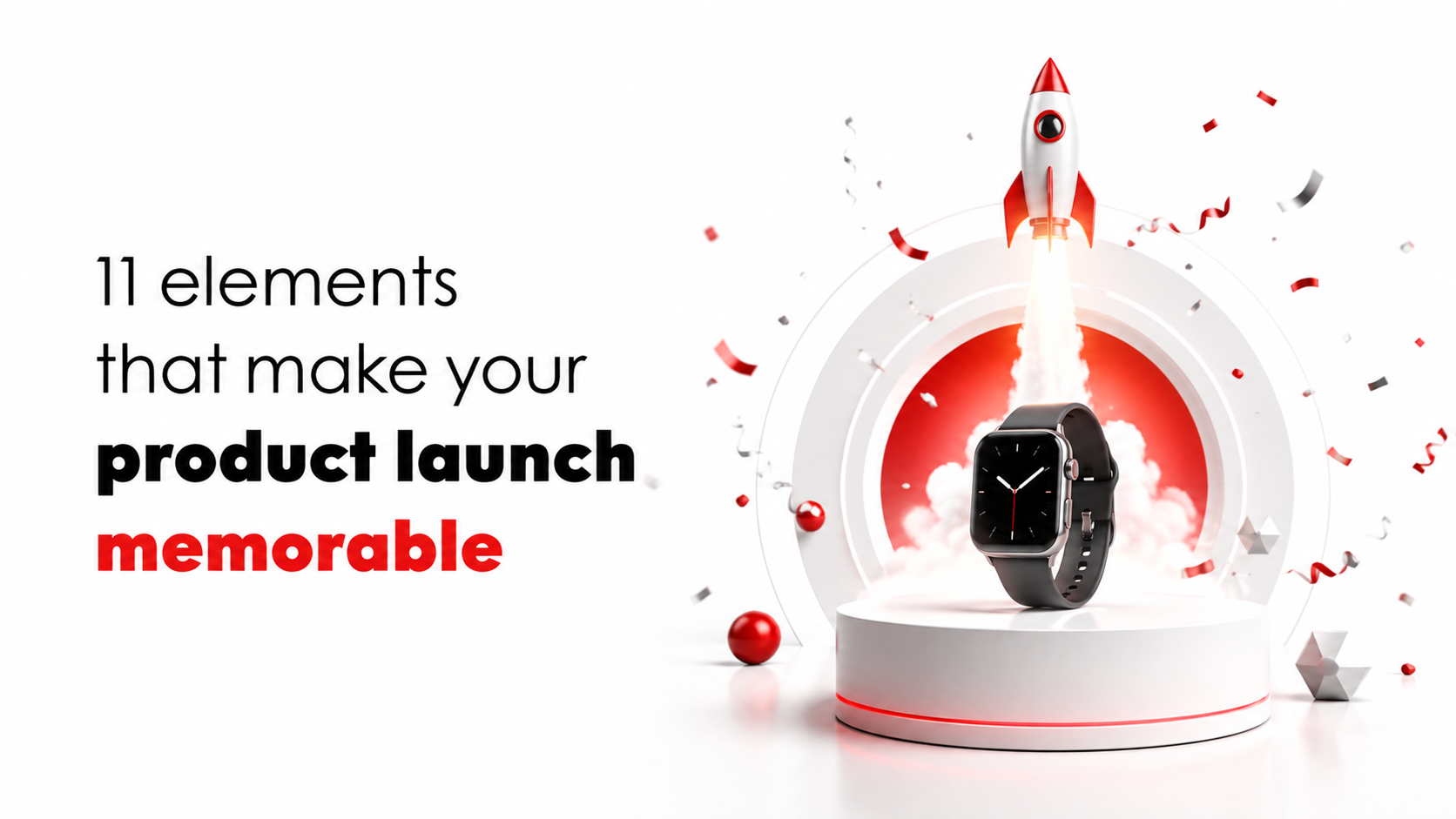
11 Elements that make your product launch memorable
What makes a product launch event memorable for a brand? Many launches fail to create lasting recall, not because the product is weak, but because the experience built around it is frequently forgettable. A launch is not a presentation; it is a brand moment that requires deliberate construction across physical, experiential, and strategic layers, and most brands underinvest in at least half of those layers.
The brands that consistently generate media coverage, qualified leads, and lasting recall treat a launch as a system. Every decision, from the entrance graphics to the post-event KPI review, reinforces a single coherent story. That is the thinking behind the product launch event elements covered in this article: a practical framework for Indian brands planning launches at any scale, from intimate press events in Thiruvananthapuram to national flagship activations in Mumbai or Delhi.
Working with a single, integrated production partner, one who manages large-format printing, display fabrication, and on-site installation as a continuous workflow, is often the difference between a launch that looks designed and one that looks assembled. The physical execution either earns credibility or spends it. Here is how to earn it.
What makes a product launch event memorable for a brand: the physical environment
Why staging and spatial design are non-negotiable
Before anyone speaks a word at your launch, the space itself is already communicating. Immersive staging creates the emotional context for the product reveal. When a room feels designed with intention, attendees assign higher credibility and premium perception to the product before the first slide appears. This is the primary mechanism through which brand positioning becomes visceral rather than abstract, and it is one of the most underestimated product launch event elements in the planning brief.
The guest journey matters as much as the focal point. Mapping the flow from entrance to demo zone to media capture area prevents congestion and ensures that every transition reinforces the narrative. A branded arrival sequence, strong lighting contrast at the reveal point, and dedicated zones for each stage of the experience all contribute to this structure. When each spatial decision is intentional, attendees feel the brand's confidence before they consciously recognise it.
Signage, display fabrication, and environmental graphics
The physical elements that bring a launch environment to life include large-format graphics, 3D lettering, acrylic displays, backlit panels, branded counters, and directional signage. Each serves a specific function: removing visual noise, focusing attention, and maintaining brand consistency from the entrance to the product display zone. Inconsistency at any touchpoint, even something as minor as mismatched signage fonts, creates subtle friction that dilutes the impression you are building.
Working with a single production partner for all these elements, rather than coordinating separate vendors for printing, cutting, fabrication, and installation, keeps the visual language consistent. GDMR Foundation's integrated workflow covers material selection, printing, precision cutting, fabrication, finishing, and on-site installation as one continuous process, so the brand team coordinates with one point of contact rather than five, which reduces errors and protects the timeline.
2. The opening sequence that captures and holds attention
Building anticipation before the product appears
A strong launch opening follows a problem-to-promise narrative arc. Start with the pain point your audience already feels, build tension around why existing solutions fall short, then introduce the product as the resolution. This sequencing transforms the reveal from a feature announcement into a payoff, audiences who feel that tension release are far more likely to remember the product and share the moment.
Teaser content, early-access invites, and pre-event communications all feed into this narrative arc before anyone arrives. Brands with a clear "why now" message in their pre-launch communications consistently generate stronger media and social traction than those who simply announce a date and a venue.
The reveal moment: what actually works
A single focal point, sensory contrast, and an immediate live demonstration are the mechanics of an effective product unveiling. Silence before sound, darkness before light, a single object in an otherwise minimal space, these are the elements that create a genuine moment rather than a managed announcement. The audience should feel the reveal before they process it intellectually.
The most common mistake is leading with brand history or company milestones before the reveal. This kills momentum because it delays the payoff audiences are waiting for. Reveal the product first, then follow immediately with a live demonstration while excitement is at its peak. The correct sequence is reveal, then proof, not context, then reveal.
3. Hands-on interaction and multi-sensory engagement
Live demos and experiential zones that convert interest into conviction
Passive audiences forget; interactive audiences remember. Live demos outperform slide decks because they remove the imaginative burden from the audience: the value becomes visible rather than described. The pattern is consistent across large-scale consumer launches, the moment someone touches the product, their evaluation shifts from intellectual to experiential.
Experiential zones work best when they are designed around specific use cases rather than a general exploration area. Use-case stations give attendees a clear context for what they are experiencing, which means they leave the station with a formed opinion rather than a vague impression. Hands-on interaction is one of the highest-conversion elements of a consumer or dealer launch, and it deserves dedicated space and dedicated production quality.
Multi-sensory touchpoints and their role in brand memory
When a product engages sight, touch, and sound simultaneously, the brain encodes the experience more deeply. Textured display surfaces, product sampling, ambient sound design, and considered material choices all affect what attendees walk away remembering. The evidence is visible in the room itself: the finish quality of a display stand communicates something about the product even when no one is consciously examining it.
Material selection and finish quality are brand decisions, not just production decisions. A display fabricated from premium substrates with precise finishing signals the same attention to detail that your product claims to embody. The physical production of your event environment is, in effect, a demonstration of your brand standards.
4. Social-ready activations and PR hooks that extend reach
Designing shareable moments, and the launch activation examples that work
The best shareable moments are designed in advance, not stumbled upon. One dominant visual focal point, vertical-friendly composition, clean backgrounds, strong lighting, and an emotional or surprising element are the principles that make a launch moment capture-ready for mobile. Spreading multiple micro-moments throughout the event, rather than relying on a single big reveal for all social content, gives attendees repeated opportunities to post.
A hashtag strategy is worth establishing before the event, not on the day. Setting a specific target, for instance, 500 social posts using the event hashtag as an illustrative planning goal, means the event design is shaped by the coverage objective rather than left to chance. When teams design backward from a measurable outcome, the activation choices become far more deliberate.
Media outreach, influencer integration, and PR hooks
A strong PR hook combines news value with a visual proof point: an unexpected use case, a before/after contrast, or a participatory moment that produces shareable audience reactions. Journalists need a one-line story; give them one before the event, not after. As a practical planning target, aiming for around 10 confirmed media placements encourages teams to shape the event with coverage in mind from the outset.
Post-event content repurposing is where a significant portion of launch ROI is realised. Footage, live demos, and attendee testimonials become follow-up social clips, sales collateral, and email sequences that work for 30 to 90 days after the event closes. The launch does not end when the lights go off; it transitions into a content asset that sustains momentum.
5. Budget realities for product launches in India
What a small, medium, and large launch actually costs
Small launches targeting 50 to 100 guests typically run between ₹4 and ₹7 lakh all-in. Medium launches for 100 to 250 guests fall in the ₹11 to ₹20 lakh range. Large or premium launches with 250 or more guests start at ₹25 to ₹60 lakh, and high-production national launches can reach ₹80 lakh to ₹2 crore depending on scale, city, and production ambition.
The wide range exists because the type of launch determines the budget mix more than headcount alone. An investor launch has a very different spend profile than a consumer activation or a dealer channel event, even at the same attendance figure. Knowing your launch type before setting the budget prevents misallocation from the first planning meeting.
Where to allocate for the strongest ROI
AV and staging typically warrant 30 to 40 per cent of the budget because they are the primary driver of perceived quality, media value, and content capture. Venue should receive enough to set the right context, approximately 20 to 30 per cent, but venue cost must not crowd out production and amplification. A premium postcode with mediocre staging produces a weaker impression than a well-produced event in a modest space.
Activation and experiential elements deserve 15 to 25 per cent when the product needs interaction to convert interest. PR and content amplification should be treated as a separate strategy with its own budget, not a small afterthought line item. The ROI from a launch is rarely captured on launch day; the real numbers come from 30 to 90 days of structured follow-through.
What makes a product launch event memorable for a brand: measurement and KPIs
Launch event KPIs: what to track and how
Five memorability metrics matter most: unaided and aided brand recall measured through pre and post surveys; branded search lift compared against a pre-event baseline; social mentions and sentiment; message pull-through (whether attendees repeat the brand's key phrases in their own words); and NPS or recommendation intent. The measurement cadence is straightforward: establish baselines before the event, monitor in real time during, then re-run surveys and analytics within 7 to 14 days after, a practical window that aligns with most post-event planning cycles.
The pre-event baseline is the step teams most often skip. Without it, post-event recall data is unattributable. You cannot demonstrate lift without a starting point, which means you cannot prove the launch's business value to the stakeholders who approved the budget.
Business impact KPIs and the post-event attribution window
Lead volume and quality, conversion rate, and revenue attributed to the launch, through UTM tagging, CRM source tracking, or promo codes, are the downstream metrics that connect the event to business outcomes. Frequently, teams fail to tag leads at source on launch day itself, which closes off the post-event attribution window before it has a chance to open. That single oversight makes it impossible to close the loop between spend and revenue.
Retention and churn of the launch cohort, trial-to-paid conversion, and pipeline value created are all metrics that require 30 to 90 days to accumulate. Using the elements in this framework as a launch event checklist is the most reliable way to ensure the measurement infrastructure, the tracking codes, the survey templates, and the attribution logic, is in place before the launch goes live.
The system, not the checklist
Ultimately, what makes a product launch event memorable for a brand is the deliberate integration of these elements across physical environment, narrative structure, interaction design, social amplification, financial allocation, and measurement. Brands that treat them as an interconnected system, rather than independent checklist items, consistently produce launches that generate media coverage, qualified leads, and lasting brand recall.
The brands that will win their next launch are the ones who start planning the physical production, staging, and branded environment as early as the product story itself. The environment is not decoration; it is the first argument for the product, and it deserves the same rigour as the messaging brief.
GDMR Foundation manages the full production chain, from printed graphics and display fabrication to precision cutting and on-site installation, so your launch looks as deliberate as it truly is. Contact the team to discuss your production brief.
FAQs
Q: What makes a product launch event memorable for a brand?
A: A memorable launch treats the event as a system where every decision—from entrance graphics to the post-event KPI review—reinforces a single coherent story. When physical, experiential, and strategic layers are deliberately coordinated, the launch generates media coverage, qualified leads, and lasting recall rather than being a forgettable presentation.
Q: Why is staging and spatial design non-negotiable for a product launch?
A: Immersive staging creates the emotional context for the product reveal and makes brand positioning feel visceral rather than abstract. A room that feels intentionally designed increases perceived credibility and premium value before any slides are shown, so staging is one of the most underestimated launch elements.
Q: How should I plan the guest journey at my launch to avoid congestion and reinforce the story?
A: Map the flow from entrance to demo zone to media capture area, creating dedicated zones for arrival, demonstration, and press interactions so each transition reinforces the narrative. Include a branded arrival sequence and strong lighting contrast at the reveal point to guide attention and prevent bottlenecks.
Q: What types of signage and display fabrication are important for a launch?
A: Key physical elements include large-format graphics, 3D lettering, acrylic displays, backlit panels, branded counters, and directional signage, each used to remove visual noise and focus attention. Consistent materials, fonts, and finishes across these touchpoints prevent subtle friction that can dilute the impression you’re building.
Q: Why work with a single integrated production partner instead of multiple vendors?
A: A single partner reduces coordination errors and protects timelines by managing material selection, printing, precision cutting, fabrication, finishing, and on-site installation as a continuous workflow. The article cites GDMR Foundation’s integrated approach as a way to keep visual language consistent and limit the brand team to one point of contact.
Q: What should the opening sequence of a launch include to capture and hold attention?
A: Use a problem-to-promise narrative arc: begin with the audience’s pain point, build tension around why current solutions fail, then present the product as the resolution. Teaser content, early-access invites, and pre-event communications should feed this arc so the reveal feels like a payoff rather than a feature list.
Q: How do I know if my launch achieved lasting recall and success?
A: Measure outcomes with a post-event KPI review focused on media coverage, qualified leads, and indicators of lasting recall, and evaluate whether every decision reinforced the core story. Use those metrics to identify gaps in the physical, experiential, or strategic layers and iterate for future launches.
Leave a comment: