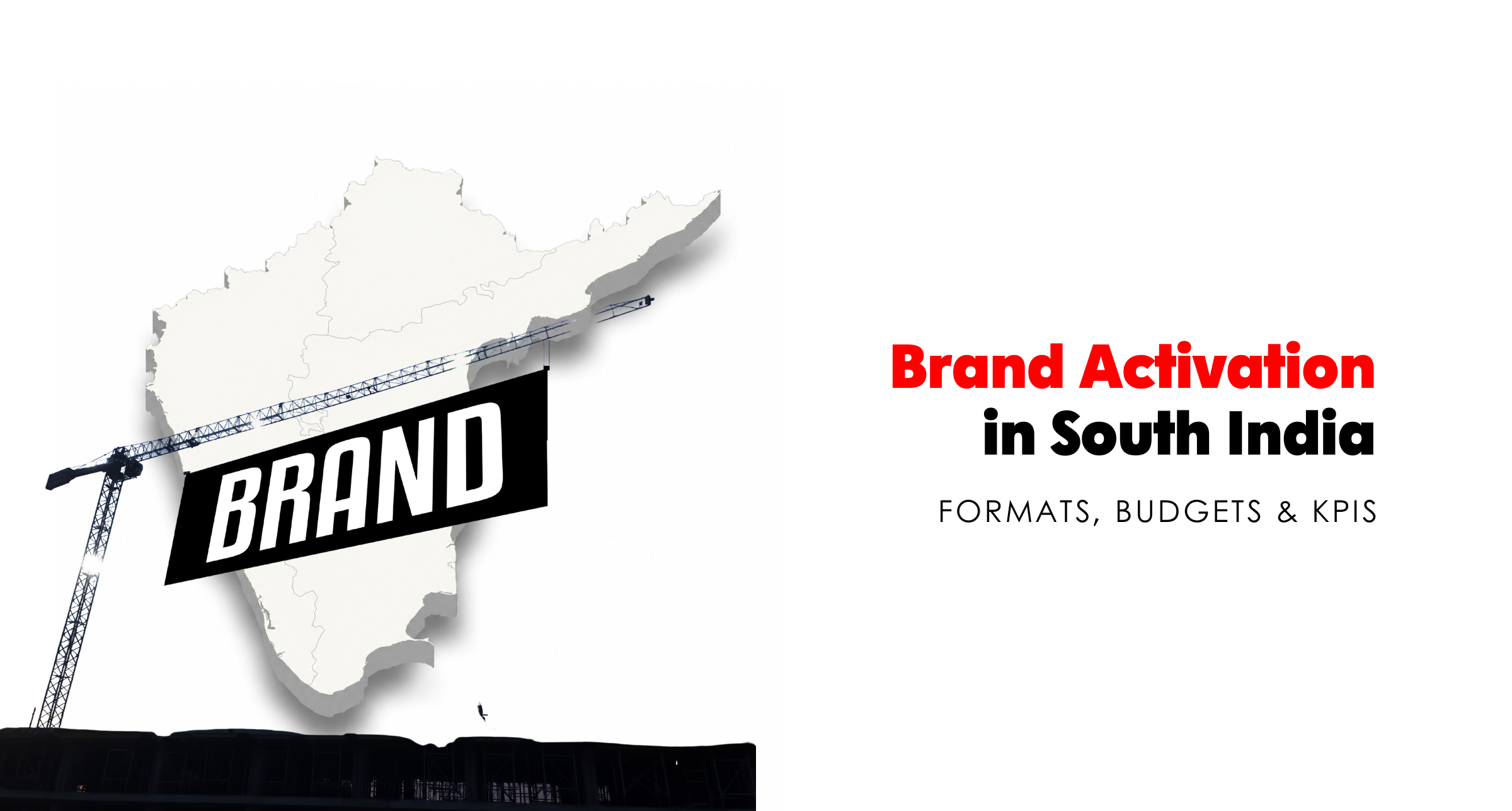
Brand Activation in South India: Formats, Budgets & KPIs
South India is not one market. It is five distinct consumer cultures spread across cities that behave, shop, and respond to brands differently. Planning a brand activation in South India means accounting for those differences from the outset, a mall activation that drives strong footfall in Bengaluru may underperform in Hyderabad if the format, language, or staffing are not calibrated to that city. The same applies to Chennai, Kochi, and Coimbatore, each of which carries its own commercial rhythm, cultural calendar, and shopper psychology.
This guide walks through everything you need to plan and execute brand activation across South India without the usual surprises: which formats actually work, what a realistic budget looks like, how permits differ city by city, and how to shortlist a partner who handles fabrication, printing, and on-site installation through one integrated workflow. At GDMR Foundation, this end-to-end process is precisely what we are built to manage, for brands that cannot afford to juggle a dozen vendors and still expect consistent results.
By the end of this guide, you will have a clear picture of formats, costs, KPIs, and a brief you can act on.
Why South India's consumer landscape changes your activation strategy
South Indian consumers are deeply attached to regional language and cultural identity. Activations that speak in Tamil, Telugu, Kannada, or Malayalam, even briefly, tend to drive stronger engagement than generic English-first campaigns in the same venue. Local practitioners consistently report that regional language creative improves dwell time and brand recall, and that promoters find conversations noticeably easier to open when the collateral reflects the audience's own language.
Cultural calendar events carry enormous commercial weight in these markets. Pongal, Onam, Ugadi, and Sankranti are not just festive moments; they are high-intent shopping windows when family-oriented decision-making accelerates purchase behaviour. Brands that time activations to these moments and localise the creative execution see meaningfully stronger engagement than those running the same generic national campaign across the calendar.
The city-by-city profiles also differ in ways that matter for format selection. Bengaluru's high-density mall footprint and tech-savvy population make it well-suited for immersive and digital-led experiential formats. Chennai's strong FMCG and family-retail culture rewards product sampling and in-store brand experiences. Hyderabad's expanding footfall zones present an opportunity for premium brand activations, though the profile is best validated with local market research before a large commitment. Kochi's tourism-retail character creates a plausible case for pop-ups and visual brand moments, a hypothesis worth testing with a pilot. Coimbatore shows rising digital adoption, which opens the door to premium experiential formats, though local consumer testing is recommended before scaling. Each city needs a calibrated approach, not a copy-pasted plan.
Brand activation South India: formats that work with local audiences
Mall activations and product sampling consistently deliver the strongest footfall-to-engagement ratios in South Indian metros, particularly for FMCG, beauty, and consumer electronics. The mechanics are straightforward: a fabricated kiosk or counter, promoter-led interaction, sample distribution, and lead capture. Mall activations regularly achieve 10% to 20% conversion on qualified interactions in Indian metro settings, making them one of the most cost-predictable formats when the brief is clearly defined.
Sampling is the fastest trial-conversion format for food, beverage, and personal-care brands. A direct product-in-hand experience materially outperforms passive brand exposure, digital or otherwise, when the product's key differentiator is sensory. If that describes your category, this is where your activation budget earns the most.
Experiential tech and AR/VR booths serve a different objective entirely. These formats perform best for premium, technology, automotive, and BFSI brands where the activation goal is brand perception and consideration rather than immediate purchase. The novelty factor in South Indian tier-1 and emerging tier-2 markets remains significant enough to drive social content generation and shareability, extending the reach of the activation well beyond the physical venue. The trade-off is cost: AR/VR booth budgets start around ₹2 lakh for basic interactive setups and can exceed ₹60 lakh when custom content production and premium booth fabrication are involved.
Street-level and guerrilla tactics work best as amplifiers within a broader activation plan, not as standalone strategies. They are strongest when hyper-local, culturally resonant, and visually shareable: branded auto-rickshaws on a high-density market street, cultural flashmobs timed to a regional festival, or market-street sampling supported by regional language collateral. Used well, these formats extend the reach and memorability of an activation without requiring significant additional budget. This kind of ground activation in South India is particularly effective when layered on top of a confirmed mall or sampling programme rather than deployed in isolation.
Budget planning: what a realistic brand activation actually costs
Cost ranges by format for brand activation in South India
Street sampling is the most accessible entry point, with costs ranging from ₹50,000 for a small local pilot to ₹25 lakh and above for a multi-city programme with large promoter teams. The primary cost drivers are promoter count, city of deployment, supervisor-to-promoter ratio, and the value of product samples being distributed. Agency management and field supervision are add-ons that brands frequently underestimate until the first invoice arrives.
Mall activations run from ₹75,000 at the lower end for a simple standee-and-promoter setup in a smaller mall, to ₹20 lakh or more for premium atrium placements in tier-1 malls with custom-fabricated counters, AV integration, and dedicated staffing. The mall placement fee and kiosk fabrication are where budget flexibility actually lies; staffing and permit costs are relatively fixed once the venue and duration are confirmed.
Pop-ups range from ₹1.5 lakh for a minimal temporary presence to ₹50 lakh and above for fully fabricated, branded retail environments with high visual merchandising quality. For a mid-scale pop-up booth, a realistic planning number for South Indian metro cities is ₹2 lakh to ₹4.5 lakh, excluding venue rent, staffing, AV, permissions, and transport. AR/VR booths start at ₹2 lakh and can exceed ₹60 lakh, with content production as the largest single cost variable.
Several line items consistently catch brands off-guard during budget reconciliation:
- Municipal and police permit fees, which vary by city and activation type
- Site-specific power and electrical charges, often billed separately by the venue
- AV rental and technician costs, particularly for screen or sound-dependent formats
- Packaging and logistics for multi-city kit movement between locations
- Setup and dismantling labour, which is rarely included in a fabrication quote
- GST on agency management fees and service charges
Build a contingency buffer of 10 to 15 per cent of your total activation budget, treat it as mandatory, not optional. It is the difference between an activation that executes cleanly and one that stalls on-site because a power connection fee was not accounted for. (The 10, 15 per cent figure reflects standard practice across multi-city field marketing; adjust based on the complexity of your specific programme.)
Permits, venue approvals, and on-ground logistics
Permit processing is where activation timelines most commonly collapse. Build two to four weeks of permit lead time into your activation calendar from day one, before any fabrication is commissioned or any vendor is briefed.
For Chennai, public-space activations require Greater Chennai Corporation approval for temporary structures, a Police NOC for crowd control and sound management, a Fire Department NOC for electrical setups or tented structures, and a CMRL NOC if your activation site falls within 50 metres of the metro alignment. The hoarding application fee is ₹2,000 with a licence fee of ₹6,000; LED or digital displays attract an additional 20 per cent.
For Bengaluru, the core approvals are BBMP municipal permission for public land use, a Police NOC for loudspeaker use or road-adjacent activity, and a Fire NOC for generators, tents, or enclosed structures. If your site is near government land, arterial roads, or metro property, the controlling agency's approval is also required on top of BBMP clearance.
For Hyderabad, GHMC permission covers public land use and temporary structures. A Police NOC is required for crowd and sound management, and a Fire NOC applies where electrical setups or enclosed activations are involved. If the site borders metro property or public utility land, the relevant agency must also clear the activation independently.
Managing logistics across cities adds a coordination layer that many brands underestimate. Fabricated displays, printed materials, counter structures, AV equipment, and branded collateral all need to move between locations on a schedule tightly linked to permit clearance dates. Using separate fabrication, printing, AV, and manpower vendors across different cities creates accountability gaps and timeline risk. Brands running multi-city activations consistently find that a single integrated production and execution partner reduces coordination cost, ensures consistency in printed materials, and lowers the risk of on-site delays.
How to shortlist the right activation and production partner
The right partner for brand activation in South India has verified on-ground presence across your target cities, in-house fabrication and print production rather than fully outsourced work, and the ability to manage installation without requiring you to coordinate multiple sub-vendors. Transparent pricing and post-activation reporting are non-negotiable. These are not aspirational criteria; they are the baseline that separates a reliable local activation vendor in South India from an agency that looks credible on a pitch deck and falls apart during execution.
Watch for these red flags: agencies that rely entirely on subcontractors, those without a documented multi-city execution history, and those who cannot show you a clear production workflow from material brief to on-site installation. Ask any prospective partner to walk you through the last three activations they managed across two or more South Indian cities, who handled fabrication, who handled permits, and what the actual on-ground delivery looked like.
GDMR Foundation is built for exactly this kind of brief. As a Thiruvananthapuram-based integrated printing, signage, fabrication, and campaign execution partner, we manage everything from large-format printed displays and retail branding elements to fabricated counters and installation across South Indian cities. This gives brands a single point of accountability across the entire production and delivery chain, removing the coordination burden that typically multiplies when separate vendors are briefed city by city. For brands expanding from North India into South Indian markets, having one integrated partner who understands regional execution makes a material operational difference.
When drafting your activation brief, include these specifics: target audience and city priorities, activation duration and scheduling constraints, brand guidelines and material specifications, KPIs expected by format, budget ceiling broken down by major cost category, and your timeline from briefing to installation-ready.
KPIs and metrics that tell you if your activation worked
KPIs must be agreed before the activation begins, not assigned after the fact. Each format naturally lends itself to different primary metrics, and conflating them produces reporting that looks busy but tells you nothing useful about performance.
For mall activations and sampling, the primary metrics are footfall reached, engagement rate (the percentage who interacted, sampled, or stopped for more than a passive glance), leads captured through form fills or QR scans, and trial conversion rate within a defined post-activation purchase window. For experiential tech formats, dwell time and social UGC volume are the leading indicators; the activation is designed to build consideration and generate shareable content, so those are the numbers that matter most. For multi-city rollouts, cost per lead and cost per acquisition are the two figures that make ROI conversations concrete and honest.
The full measurement stack for any brand activation in South India should include:
- Total footfall and reach at the activation space
- Engagement rate as a percentage of total footfall
- Leads captured via QR scans, app installs, registrations, or contact details
- Trial conversion rate for sampling-led activations
- Social UGC volume: Reels, posts, hashtags, and shares generated during and after the activation
- Cost per lead and cost per acquisition as the final ROI anchors
A brief that lists KPIs upfront makes vendor evaluation cleaner, post-campaign reporting honest, and the conversation about what to improve next time far more productive. Activations that skip this step rarely produce data that justifies the investment to a CFO or a brand committee.
Make these four decisions before your activation goes live
Executing brand activation in South India successfully comes down to four decisions made early: choosing the right format for your audience and city, building a budget that accounts for every line item including permits and logistics, locking in a production and execution partner with verified integrated capability, and defining KPIs before a single display is fabricated or a single promoter is briefed.
South India rewards brands that localise, from the language on a printed standee to the cultural timing of a mall activation. Brands that treat it as one homogenous market typically see mediocre results, spend more on corrections than they budgeted for surprises, and miss the commercial windows that regional calendar events open every year.
Use this guide as your planning checklist. If you are working across multiple South Indian cities and need a single partner for printing, fabrication, signage, and on-site installation, that is exactly the brief GDMR Foundation is built to receive. For support with brand activation South India, whether you are planning a single-city pilot or a multi-city rollout, share your city list, timeline, and objective, and we will scope a plan from there.
FAQ
What formats work best for brand activation in South India?
Mall activations and product sampling consistently perform well across South Indian metros, especially for FMCG, beauty, and consumer electronics. Sampling delivers fast trial-to-conversion when the product’s key differentiator is sensory, while fabricated kiosks with promoter-led interactions and lead capture give predictable outcomes.
How important is using regional language in South India activations?
Regional language creative materially improves engagement, dwell time, and brand recall in South India. Activations that use Tamil, Telugu, Kannada, or Malayalam — even briefly — make conversations easier for promoters and resonate more strongly than English-first campaigns.
Which South Indian cities suit digital or immersive activations versus sampling-led formats?
Bengaluru’s dense mall footprint and tech-savvy audiences suit immersive and digital-led experiential formats. Chennai favors product sampling and in-store experiences, Hyderabad can host premium activations but needs local validation, Kochi is good for pop-ups and visual moments, and Coimbatore shows rising digital adoption that merits consumer testing before scaling.
What KPIs should I track for a South India brand activation?
Track footfall, qualified engagements, dwell time, lead capture, and conversion from interaction to purchase or follow-up. Also monitor brand recall and sampling conversion rates, since those metrics predict longer-term impact in these markets.
What conversion rates can I expect from mall activations?
In Indian metro settings, mall activations regularly achieve about 10% to 20% conversion on qualified interactions. That range makes mall activations one of the more cost-predictable formats when the brief and targeting are clear.
How should I time activations around South Indian festivals?
Plan activations to coincide with major regional festivals like Pongal, Onam, Ugadi, and Sankranti because these are high-intent shopping windows driven by family decision-making. Localising creative and timing campaigns to these moments typically produces stronger engagement than running generic national campaigns.
How do I shortlist a partner to handle fabrication, printing, permits and on-site installation?
Look for an integrated partner that manages fabrication, printing, permits, staffing and on-site installation through a single workflow to avoid juggling multiple vendors. The article recommends working with an end-to-end provider like GDMR Foundation to ensure consistency across cities and simplify permit and logistics differences.
Leave a comment: