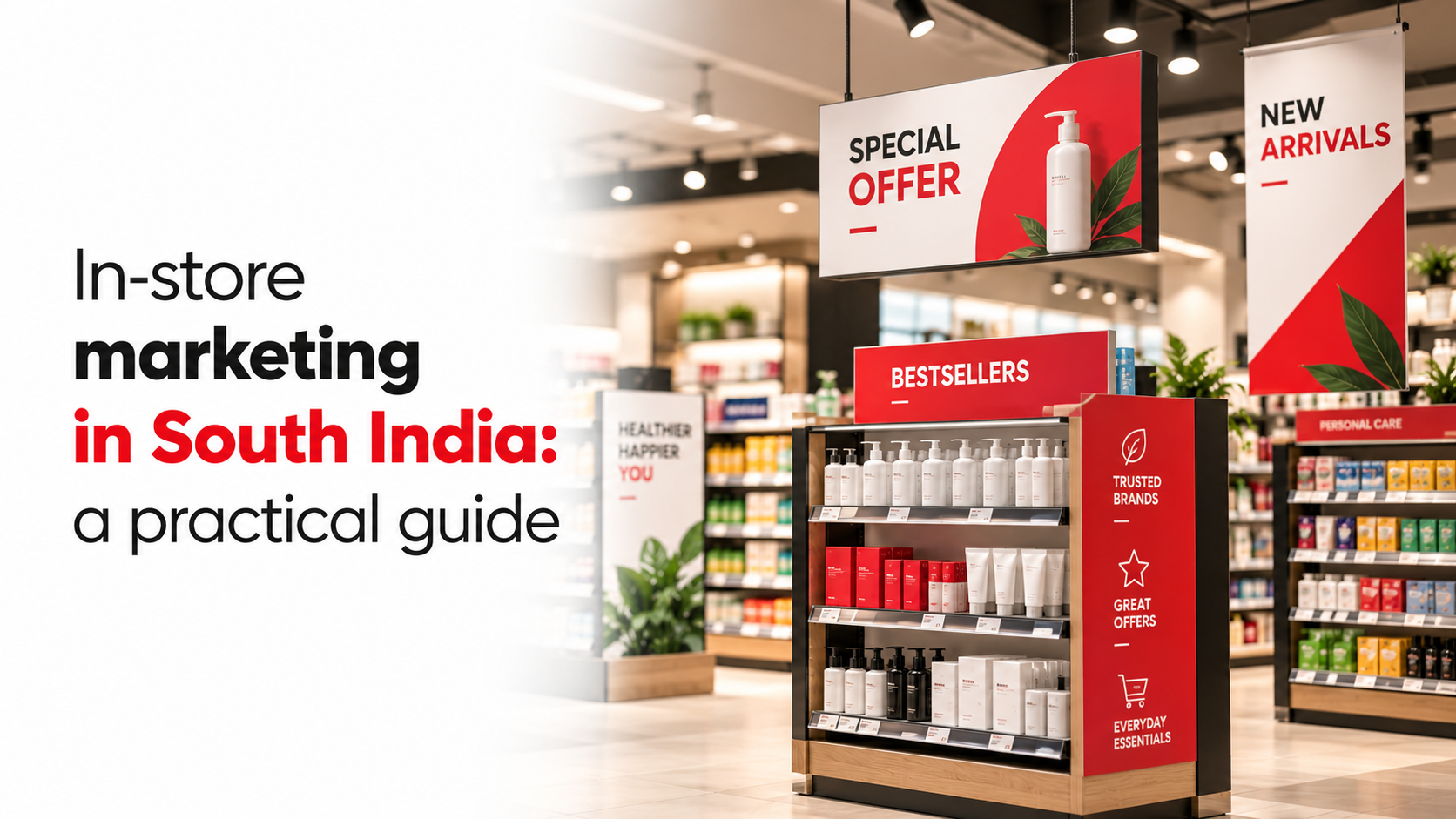
In-store marketing in South India: a practical guide
In-store marketing in South India cannot be treated as a single market brief, and many brands discover this the hard way when conversion stays flat despite solid creative work. The problem is rarely the creative itself. It is the assumption that South India is one homogeneous market. It is not. It is five distinct shopper cultures, four primary languages, and a festival calendar that runs on its own rhythm. That rhythm looks nothing like the Diwali-centric planning most national retail teams default to. Teams that account for these realities pull measurable uplift. Those who ignore them waste activation budgets on display materials that shoppers walk past without registering.
A well-planned in-store campaign across South India calls for the right creative by state, the right physical materials for each store format, and a production partner who understands multi-state rollouts from the ground up. At GDMR Foundation, our Thiruvananthapuram-based print, signage, fabrication, and campaign execution team works with retail brands to bridge the gap between strategy and shelf-level execution across Kerala, Tamil Nadu, Karnataka, Andhra Pradesh, and Telangana. This article covers everything a marketing team needs to plan an in-store activation here: shopper behaviour by state, the festival calendar that actually drives footfall, the physical touchpoints that convert, realistic budgets, a real three-state campaign example, and a simple measurement framework.
Why South Indian shoppers behave differently in-store
Building a region-specific in-store strategy is not the advanced option here, it is the baseline requirement for any campaign that expects to produce results rather than mere presence. South Indian shopper behaviour is shaped by three pillars: language, visual culture, and category-specific purchase psychology. Getting these right is the difference between display materials that sell and display materials that simply occupy shelf space.
Language on your POS is not optional
Tamil, Kannada, Malayalam, and Telugu are not interchangeable add-ons to your display suite. They are primary communication channels for frontline staff and shoppers, particularly outside premium urban pockets. Tamil-language POS materials tend to outperform English-only equivalents in Chennai's neighbourhood and market-led retail formats, where regional-language communication is the default for a significant share of shoppers. Kannada and Telugu displays support staff usability and build shopper trust in Bengaluru and Hyderabad respectively. Brands that localise shelf-talkers, counter headers, and display copy by state see meaningfully better engagement at the point of sale, and this holds across both in-store promotions in South India's metros and activations in smaller Tier 2 markets.
Visual cues and colour strategy by state
Colour choices in South Indian retail displays carry cultural weight that pan-India brand guidelines rarely account for. Premium retail formats in Bengaluru and Chennai respond well to restrained, high-contrast palettes that signal quality. Mass-market and promotion-led POS in Tier 2 South Indian markets benefits from stronger contrast and cleaner focal points. The universal rule across all formats: a single strong focal point, benefit-led messaging readable at a glance, and storytelling through the display rather than dense printed copy.
Regional shopping habits and what they mean for display planning
South Indian shoppers, particularly in Kerala and Tamil Nadu, often show higher consideration cycles in categories like textiles, jewellery, and consumer appliances, tending towards deliberate, high-involvement purchase decisions. This affects dwell time and the kind of in-store environment that actually produces a purchase decision. Displays that offer product context, local use-case messaging, and easy navigation consistently outperform decorative or generic setups. Understanding this before you brief your display production is the difference between materials that earn their cost and materials that do not.
Planning in-store marketing in South India around the festival calendar
The South Indian retail calendar does not follow a single national beat. Each state has its own defining shopping window, and the brands that plan production timelines around these state-level peaks capture the full demand curve. Those who scramble at the last minute lose prime shelf presence at the exact moment shoppers are ready to buy.
The January window: Pongal, Sankranti, and the first retail peak
Pongal (around 14, 17 January) is Tamil Nadu's single most important retail window, driving peak demand for appliances, apparel, textiles, and consumer durables. Karnataka and Andhra Pradesh see a parallel Sankranti surge across the same dates. Brands that brief their production partner in November and have display materials shop-ready by early January capture the full demand window. Those who begin production in December typically lose two to three weeks of prime shelf presence at the worst possible time.
The August, November stretch: Onam, Ganesh Chaturthi, and Diwali
This is the most intense sustained retail activation period across all South Indian states. Onam (late August to early September) is Kerala's defining shopping season; a well-executed lifestyle retail activation during Onam generated a 42% weekend footfall lift, illustrating the scale of demand this window can unlock. Ganesh Chaturthi drives discretionary retail in Karnataka and Andhra Pradesh. Navratri, Dussehra, and Diwali (October and November) close out the season across all five states. Smart brands treat this not as a series of individual festival campaigns but as a single four-month campaign arc requiring consistent display language and a coherent in-store visual identity from state to state.
Building your campaign production timeline
The practical rule is to brief your production and execution partner eight to ten weeks before the activation window opens. This allows time for creative localisation by state, material procurement, print production, fabrication, quality checking, dispatch coordination, and on-ground installation across multiple store locations.
Teams that compress this timeline to four weeks typically compromise on quality, consistency, or both, a damaging outcome when you are competing for shopper attention at the busiest retail moment of the year.
Physical touchpoints that convert in in-store campaigns across South India
Not every touchpoint earns equal purchase weight. The materials below are the ones that actually move decisions in South Indian retail environments, from the moment a shopper approaches the entrance to the moment they reach the point of sale.
Window graphics and facade branding
Window graphics are the first physical brand signal a shopper encounters. In high-footfall South Indian retail corridors, particularly in Chennai, Kochi, and Bengaluru's commercial belts, strong window branding drives walk-in rates before the shopper has crossed the threshold. Vinyl window graphics, backlit films, and full facade wraps produced at large format carry the heaviest load at this stage of the shopper journey. The key variable is high-resolution printing on the right media for the ambient light conditions of each specific store. A film that performs well in a bright open-frontage store in Chennai may read very differently in a covered mall unit in Bengaluru.
POSM displays, shelf-talkers, and branded counters
Point-of-sale materials are where in-store marketing across South India becomes granular. Shelf-talkers in regional languages, free-standing display units, standees, and branded promotional counters guide shopper attention along the purchase journey in a way that no digital touchpoint can replicate at shelf level. For multi-brand retail environments like large electronics or fashion chains, a well-fabricated branded counter distinguishes your product from the adjacent shelf immediately. POSM produced on the right substrate (acrylic, PVC board, foam board, or ACP, depending on the store format) signals brand quality without the shopper needing to read a single word of copy.
In-store sampling and promoter-led activations
Promoter-led sampling and demonstration activations work best when they are supported by purpose-built display structures, not run from bare folding tables. A promoter station with a well-branded counter, product display, and clear benefit messaging converts considerably better than a promoter standing alone. For categories like FMCG, beauty, food, and consumer electronics, the combination of a trained promoter and a branded physical environment is the standard for driving trial and immediate purchase in South Indian modern trade. The display structure is not a backdrop, it is half the conversion mechanism.
What in-store activations actually cost across South Indian cities
Budget planning is where most national marketing teams go wrong for South India, either by under-investing in production quality or by applying metro-India cost assumptions to markets where the dynamics are different. The figures below are working market benchmarks, not fixed tariff cards, but they give you a credible planning baseline before you go into agency conversations.
For South India's major metros, Bengaluru, Chennai, Hyderabad, Kochi, promoter manpower runs approximately ₹2,500 to ₹4,500 per promoter per day depending on the category and experience level required. A five-promoter sampling pilot across ten days in a single city costs roughly ₹1.5 lakh in manpower before agency fees and GST. A small single-city sampling test starts around ₹50,000 for a short window and scales from there.
On the production and display side, basic in-shop merchandising work runs around ₹1,000 per outlet for simple installations. Richer in-store branding, covering aisle takeovers, full POSM suites, shelf-talker programmes, and branded promotional counters, sits in the ₹15,000 to ₹2.5 lakh per store per month range, depending on total material volume, store footprint, and material specification. For multi-location rollouts, consolidating production with a single integrated partner significantly reduces per-unit cost and eliminates the consistency gaps that appear when different vendors handle different cities on the same campaign.
How one retail brand ran a three-state in-store campaign through a single partner
A lifestyle retail brand planning an Onam-to-Diwali campaign needed window graphics, branded promotional counters, POSM suites, and in-store display structures across 18 stores spanning Kerala, Tamil Nadu, and Karnataka. The production challenge was not just volume. It was consistency across three different store layouts, two regional language requirements (Malayalam and Tamil), and a compressed six-week production-to-installation timeline that left no margin for coordination failures between separate vendors.
The brand worked with GDMR Foundation to manage the full production workflow: artwork localisation by state, large-format printing, rigid substrate fabrication, branded counter assembly, finishing, packing, logistics coordination, and on-ground installation across all three states. Running the entire workflow through a single integrated production partner eliminated the coordination gaps that typically appear when separate print vendors, fabricators, and installation teams are stitched together mid-campaign, the kind of gaps that result in materials arriving late, inconsistent finishes across stores, or display structures that do not match the approved artwork.
The brand entered the Onam window with display materials installed and shop-ready across all 18 stores on the same day. Visual consistency across Kerala, Tamil Nadu, and Karnataka held to a standard that would have been very difficult to achieve with multiple regional vendors managing separate production streams. The case makes a practical point about retail activation across South India: production capability and multi-state execution experience matter as much as creative quality.
Measuring your in-store campaign: benchmarks and a simple KPI framework
Measurement is where many in-store campaigns fall short, not because the results are not there, but because the data was never set up to capture them. Campaign results from South Indian markets offer useful reference points for setting internal expectations. In one Bengaluru activation for an Apple reseller, the campaign returned a 30% sales increase and over 12,000 visitors in two weeks. A Samsung Experience Centre campaign in Hyderabad produced a 37% rise in customer enquiries. These are not guarantees for every brand or category, but they are credible benchmarks for briefing your team before a campaign goes live.
Sales uplift and footfall are the headline metrics. The supporting KPIs that help you diagnose performance and improve future campaigns include:
- Display compliance rate across stores (are materials installed correctly and consistently in every location?)
- Promoter engagement rate and trial-to-conversion ratio for sampling activations
- Average transaction value in activated versus non-activated stores during the same period
- Customer feedback collected at the promoter station or counter
Building a simple comparison between activated and control stores gives you the cleanest ROI picture. For the post-campaign review, collect five data points per store consistently: footfall change versus the same period in the prior year, sales value versus target, display compliance audit score, promoter activity log, and customer feedback. These five inputs, gathered consistently across all locations, give you a repeatable measurement framework for every subsequent in-store activation campaign in South India.
The playbook that works here is specific, not generic
In-store marketing in South India rewards specificity. Generic campaign materials, pan-India display templates, and single-city thinking all leave conversion on the table. The brands that consistently pull results in this market plan their activation calendar around state-level festivals, localise display materials by language and visual culture, choose physical touchpoints that match the store format, and work with a production and execution partner who can deliver consistency across multiple states from one integrated workflow.
If you are planning a multi-location retail activation across South India, the questions to ask your production partner are straightforward: Can you manage printing, fabrication, finishing, and installation across Kerala, Tamil Nadu, and Karnataka through a single workflow? Can you localise materials by state without adding weeks to the timeline? Can you deliver consistency across 10, 20, or 50 store locations on the same day? The answers will tell you quickly whether you have found the right partner for the region.
The GDMR Foundation team handles exactly this kind of end-to-end in-store campaign execution across South India, from material selection and artwork localisation to print production, display fabrication, packing, and on-ground installation. If you are ready to plan your next retail activation, get in touch with our team to discuss your brief, timeline, and store count. We will give you a clear picture of what is achievable and what it will cost.
FAQs:
Q: Why can't I treat South India as a single market for in-store marketing?
A: South India is not homogeneous: it comprises five distinct shopper cultures, four primary languages, and a festival calendar that follows its own rhythm. Assuming uniformity leads to flat conversion even with good creative, whereas state-specific creative and execution drive measurable uplift.
Q: How important is using local languages on POS materials in South India?
A: Local languages are essential, not optional. Tamil, Kannada, Malayalam, and Telugu function as primary communication channels for frontline staff and shoppers. Brands that localise shelf-talkers, counter headers, and display copy by state see meaningfully better engagement across both metros and Tier 2 markets.
Q: What visual and colour strategies work best across South Indian retail formats?
A: Premium formats in Bengaluru and Chennai respond well to restrained, high-contrast palettes that signal quality, while mass-market and promotion-led POS in Tier 2 markets benefit from stronger contrast and cleaner focal points. Across all formats, use a single strong focal point, benefit-led messaging readable at a glance, and tell the story visually rather than with dense copy.
Q: How do regional shopping habits in Kerala and Tamil Nadu affect display planning?
A: Shoppers in Kerala and Tamil Nadu often have longer consideration cycles in categories like textiles, jewellery, and appliances, increasing dwell time and demand for context. Displays that provide product context, local use-case messaging, and easy navigation outperform decorative or generic setups in converting those shoppers.
Q: What operational elements are required for a successful multi-state in-store activation in South India?
A: You need the right creative by state, the right physical materials for each store format, and a production partner experienced in multi-state rollouts from the ground up. The article highlights GDMR Foundation’s Thiruvananthapuram-based print, signage, fabrication, and execution team as an example of this capability.
Q: Should national teams use Diwali-centric planning for South India activations?
A: No, the South Indian festival calendar runs on its own rhythm and often looks nothing like Diwali-centric planning used nationally. Teams that align activations to local festival timing and shopper rhythms see better footfall and conversion, while ignoring them wastes activation budgets.
Q: What are the baseline requirements for an in-store campaign that expects to produce results in South India?
A: A region-specific strategy is the baseline: account for language, visual culture, and category-specific purchase psychology when briefing displays and production. Getting those three pillars right distinguishes materials that sell from those that merely occupy shelf space.
Leave a comment: