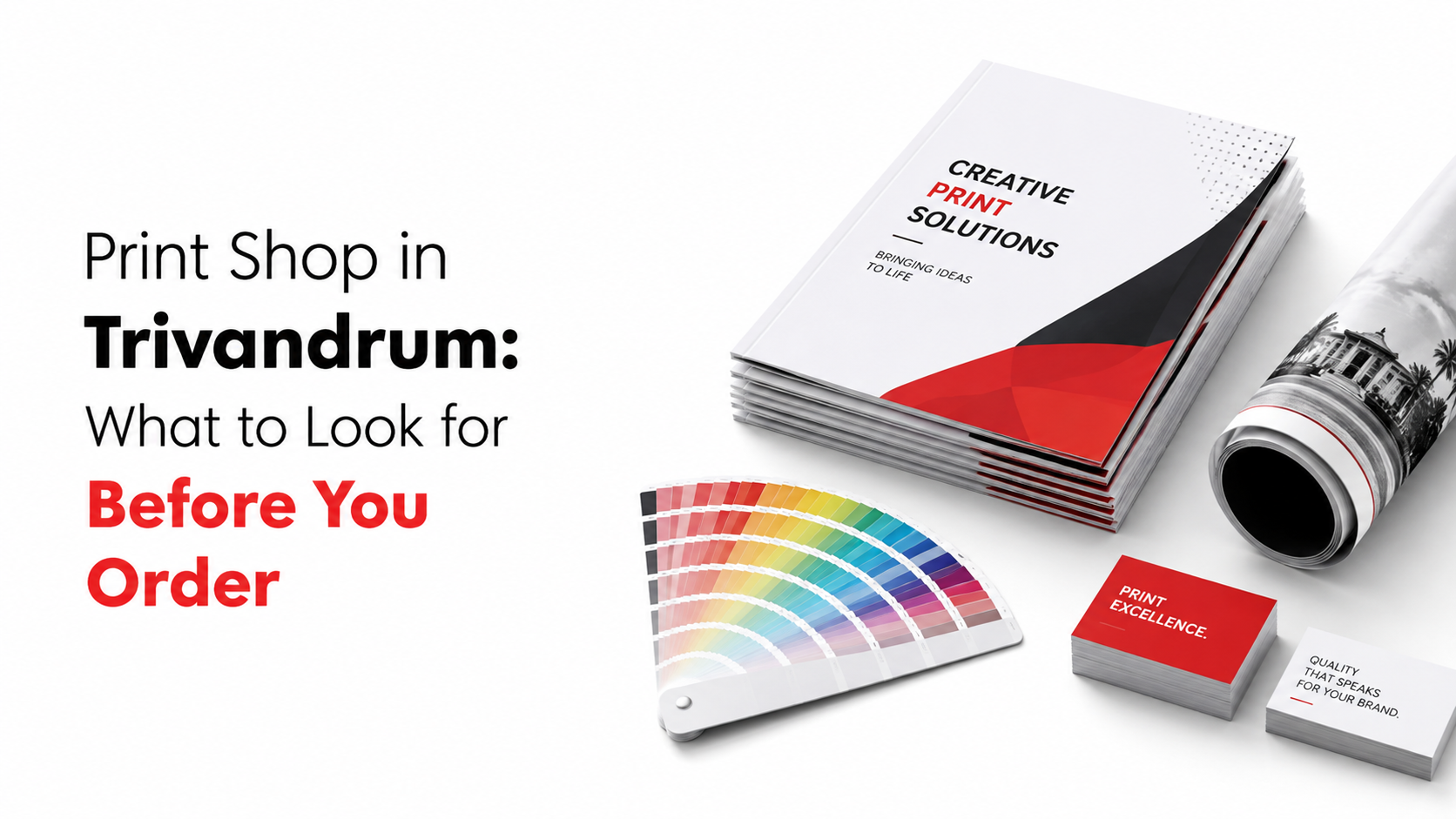
Print Shop in Trivandrum: What to Look for Before You Order
When choosing a print shop in Trivandrum (Thiruvananthapuram), many buyers make the same costly mistake: they pick a shop based on price, send over the artwork, and then discover the shop cannot handle the substrate they need, does not offer lamination in-house, or will not meet the deadline stated at the counter. By that point, reprinting elsewhere costs more time and money than the original saving was worth.
Trivandrum has a genuinely wide range of printing services, from small DTP centres handling document printouts to full-scale production facilities managing retail branding, signage fabrication, and multi-format campaign rollouts. Knowing where your job fits in that range before you walk in or send artwork is the difference between a smooth execution and a scramble. This guide covers five factors that separate a capable print partner from one that will let you down at the worst possible moment.
1. What print formats does the shop actually handle?
Digital printing: the right fit for short runs and fast jobs
Digital printing is the backbone of most commercial print shops in Trivandrum. It covers business cards, flyers, brochures, posters, and short-run catalogues, and it works best at quantities between 50 and 500 pieces. Turnaround is fast because there are no plates to prepare, and per-unit cost is reasonable at low volumes. Shops like Digital House and Ashoka Printers run digital as their core offering, making them a solid choice for standard marketing collateral with a short deadline.
The important caveat is that digital printing is the entry point, not the full picture. When your brief extends beyond flat commercial print into large-format graphics, rigid substrates, or display fabrication, many digital-only shops in Trivandrum will not be able to help you without referring the work elsewhere.
Offset printing: when volume and colour accuracy matter
Offset becomes the better choice once quantities rise and colour consistency becomes critical. Wedding cards, stationery ranges, brochures printed at 1,000 copies and above, and packaging mock-ups all benefit from offset production because the per-unit cost drops as volume increases, and Pantone matching is more reliable than CMYK digital output. St. Joseph's Press in Thycaud and Vijaya Press both carry offset capability alongside digital, which gives buyers flexibility when the job shifts between run sizes.
Not every print shop in Trivandrum carries offset equipment, so it is worth confirming this before submitting artwork. Arriving with an offset-ready PDF to a digital-only shop wastes everyone's time, particularly if the job has a fixed event date or campaign launch window.
Large-format and specialty printing: the capability gap many shops have
Large-format printing covers flex banners, vinyl graphics, backlit films, wall graphics, mesh banners, and hoardings. UV printing on rigid media, including acrylic, ACP, PVC board, foam board, and metal, is a higher-tier capability that retail brands and event teams regularly need for display panels, signage, and branded interiors. Romanson Print House is one of the few Trivandrum providers explicitly listing large-format output alongside digital and offset.
Many general print shops in Trivandrum cannot handle UV printing on rigid substrates. This gap forces buyers to coordinate with a separate fabricator, which creates handover delays, inconsistent quality control, and diffused responsibility when something goes wrong. Recognising this gap early lets you make a better choice at the briefing stage rather than discovering it mid-production.
2. Turnaround time: what is realistic for different jobs
Same-day and urgent printing in Trivandrum
Same-day printing is available from select providers in Trivandrum. Justdial listings tag several local shops with same-day options, and PJ Graphics in Manacaud is listed as a 24-hour operation. For urgent needs, these are reasonable first calls. The key limitation to understand is that same-day output is generally confined to digital print on standard stock: single-colour flyers, document printing, or basic stickers.
Any job requiring lamination, contour cutting, or fabrication carries additional lead time because those stages cannot be compressed without compromising quality. A shop that promises same-day delivery on a laminated display panel is either outsourcing it at a premium or cutting a corner you will notice when the material arrives.
Standard lead times by job type
Business cards and A4 flyers typically take one to two working days at most digital print shops in Trivandrum. Offset runs for wedding cards or catalogues usually require three to five days minimum, accounting for plate preparation, press time, and drying. Large-format vinyl graphics, acrylic signs, and display fabrication require three to seven days depending on complexity, availability of materials, and the number of finishing stages involved.
Build these benchmarks into your brief before you contact a shop, not after. The single biggest source of buyer frustration in the print industry is arriving to collect a job that is not ready because the timeline was discussed in optimistic terms at the point of enquiry rather than confirmed in writing at order placement.
How integrated production affects your timeline
When printing, cutting, lamination, and finishing are handled inside one facility, the handover delays between vendors disappear. A shop that outsources lamination or contour cutting to a third party adds an unpredictable day or two to every job, and that third party is not accountable to your deadline the way a direct supplier is. For complex or multi-component briefs, an integrated production facility consistently outperforms a single-process shop on overall timeline and final quality.
3. Materials and finishing: where print quality is actually decided
Paper, film, and flex: understanding your substrate options
The most common substrates buyers in Trivandrum ask about are art paper and card for commercial print jobs, vinyl for wall graphics and vehicle wraps, flex for banners and hoardings, and fabric for backdrops and exhibition displays. Not all print shops stock the same weight, finish, or brand of substrate. For example, 170 gsm art paper behaves very differently from 300 gsm card under lamination, a distinction that matters considerably when durability or presentation quality is a priority. Asking specifically about GSM, coating type, and whether the shop stocks multiple material options gives you a reliable quality signal before committing to an order.
Rigid media printing for displays and signage
Rigid substrates (acrylic, ACP, foam board, PVC board, wood, and metal) are relevant for retail display panels, signboards, directional signs, exhibition stands, and branded interiors. Direct printing on these materials requires UV flatbed printing equipment and CNC or laser cutting capability. Both are absent from many general digital print shops in Trivandrum. Buyers sourcing display fabrication from a commercial printer without these capabilities will often need to split the job across multiple vendors, and the coordination cost adds up quickly across a multi-format or multi-location brief.
Finishing options that change the final result
Lamination (matte, gloss, or soft-touch), precision cutting (contour, CNC, or laser), binding, eyelet punching, and custom shaping are finishing stages that most buyers overlook when comparing quotes. A lower-priced quote that excludes lamination or cutting may end up costing more once those services are sourced separately from a finishing house. Finishing quality is also the most visible differentiator between a premium printed piece and one that looks rushed. Ask any print shop in Trivandrum whether finishing is handled in-house or sent out before you accept their quoted lead time.
4. Price benchmarks for common print jobs in Trivandrum
Business cards, flyers, and posters
Business cards in Trivandrum typically range from ₹170 to ₹500 for 100 cards on standard stock, rising to ₹1,500 and above for premium finishes, spot UV, or special treatments. A4 flyers run from approximately ₹400 for 100 copies to ₹4,000 for 1,000 on coated paper. Minimum order quantities for digital print are commonly 50 to 100 for cards and as low as 25 for flyers. A5 flyers typically fall in the ₹2 to ₹8 per piece range depending on quantity and finish, while A4 posters on standard art paper sit around ₹3 to ₹15 per piece. These figures reflect the standard and mid-range options available locally; premium substrates, double-sided printing, and lamination all add to the final cost.
Wedding cards and invitations
Wedding card pricing in Trivandrum varies significantly based on paper weight, finish, inserts, and quantity. Simple printed cards can start around ₹15 to ₹35 per piece for standard digital print runs; mid-range options with better stock and finishes typically fall between ₹35 and ₹80 per piece; premium offset-printed suites with foil stamping, embossing, or boxed presentation can exceed ₹100 per card. Suppliers for these premium suites often set higher minimum order quantities, buyers should confirm MOQs directly with their chosen printer, as requirements vary. Those who want embossed details or handcrafted finishes should also confirm that the shop handles these in-house rather than outsourcing the finishing work.
Understanding value beyond the per-unit price
The cheapest quote is rarely the best deal. Colour accuracy, substrate quality, finishing consistency, and on-time delivery all carry a cost that low-rate shops recover by cutting corners elsewhere. When a job requires multiple materials, formats, or stages, the coordination cost of splitting work between low-cost vendors adds up quickly in time, revisions, and rejected batches. The true cost of a print job includes every hour spent chasing updates from two or three separate suppliers.
5. Quality benchmarks to check before placing an order
What reviews and past work tell you
Look for shops with verifiable reviews on platforms like Justdial, Google Maps, or ThreeBestRated, and ask for printed samples or a portfolio of recent work before placing a large order. Digital House, for example, publishes more than 250 verified reviews alongside a named project portfolio, giving buyers a clear signal of capability and reliability before committing. Shops without any visible track record warrant extra caution on deadline-sensitive or brand-critical jobs, particularly if the brief involves specialty substrates or fabrication.
Colour accuracy, resolution, and proofing standards
Colour accuracy is determined by the printer's calibration process, the substrate used, and whether a proof is offered before full production runs begin. Ask any print shop whether they produce a physical colour proof or a calibrated digital soft proof for approval before the full job goes to press. For brand-critical materials, including retail graphics, event backdrops, and product packaging mock-ups, accepting production without a proof is a risk no marketing manager should take. A mismatched Pantone shade on 500 pieces of printed collateral is an expensive lesson in skipping the proof stage.
Asking the right questions before you submit artwork
Before sending files to any print shop in Trivandrum, confirm these specifics: the accepted file format (PDF/X-1a or AI with bleed and crop marks), colour mode required (CMYK, not RGB), minimum resolution for commercial output (300 dpi), substrate options for your specific job, whether finishing services are handled in-house, and the confirmed lead time from artwork approval to collection or delivery. These questions take two minutes and prevent hours of revision and frustration. A professional print shop answers them without hesitation; one that cannot is telling you something important about how they operate.
When an integrated print facility is the smarter choice
What "integrated" actually means in a print context
An integrated print facility handles multiple stages of production under a single roof: digital printing, large-format printing, UV printing on rigid substrates, precision cutting and engraving, lamination, finishing, signage fabrication, and on-site installation. The alternative, which is the standard setup for many buyers in Trivandrum, involves patching together a digital print shop, a flex banner printer, and a fabricator separately. That approach creates handover gaps, inconsistent quality control, and diffused responsibility when quality issues arise on a deadline.
How to choose a print shop in Trivandrum: the case for GDMR Foundation
GDMR Foundation's Printing Unit in Trivandrum is built around an integrated production model. According to the company, the facility manages commercial digital printing, large-format graphics, UV printing on rigid media including acrylic, ACP, PVC board, wood, and metal, CNC and laser cutting, lamination and finishing, signage fabrication, retail display production, and campaign installation through one coordinated workflow. For retail brands, advertising agencies, corporate marketing teams, and event organisers who need multiple print and display formats from a single accountable partner, this model removes the vendor coordination problem entirely.
GDMR Foundation has worked with major retail brands including Titan, Shoppers Stop, Tommy Hilfiger, and Lakmé on retail displays and campaign rollouts, engagements that reflect production standards built around brand-critical work where quality and consistency are non-negotiable. Buyers evaluating a print partner for complex briefs will find that this level of documented brand experience provides a meaningful baseline for assessing capability.
Choosing between a general print shop and a full-service facility
For a one-off document print or a small batch of business cards, a local digital print shop is perfectly adequate. For campaign rollouts, multi-format retail branding, event graphics, branded displays, or any job requiring fabrication and installation, an integrated facility with end-to-end capability is generally the safer option for protecting your timeline and brand consistency. Buyers who underestimate job complexity at the briefing stage are the ones who end up reprinting at a higher cost. The decision about which kind of partner to engage should be made at the brief, not after the first batch comes back wrong.
Making the right call for your next print job
The five factors that determine whether a print shop in Trivandrum can actually deliver your job are service range, turnaround capability, material and finishing options, transparent pricing, and verifiable quality standards. For simple commercial print jobs, a well-reviewed digital shop with offset capability is often sufficient. The benchmark shifts significantly when the brief extends into fabrication, display production, or multi-location campaign execution.
The right print partner in Trivandrum depends entirely on the complexity of the job at hand. A shop that handles your business cards perfectly may not be equipped to manage a retail window branding rollout across five stores. Asking the right questions before you commit is the clearest way to avoid that mismatch.
If you are working on a print brief that involves more than one format or material, reach out to GDMR Foundation's Printing Unit in Trivandrum to discuss what an integrated production workflow can do for your project. The team can walk through your brief, confirm capability against your substrate and finishing requirements, and provide a clear picture of lead times and pricing before you commit.
FAQs:
Q: What should I check before choosing a print shop in Trivandrum?
A: Confirm the formats the shop actually handles (digital, offset, large-format/UV and rigid substrates), whether finishing like lamination is done in-house, and realistic turnaround times. Also verify they can meet your deadline and handle the specific substrate or display fabrication your job requires to avoid costly reprints or handover delays.
Q: When is digital printing the right choice and when should I use offset?
A: Digital printing is best for short runs and fast jobs—typically 50–500 pieces—where quick turnaround and no plate setup are priorities. Offset becomes preferable once quantities rise (for example, 1,000+ copies), when per-unit cost falls, and when colour consistency or Pantone matching is critical.
Q: Which Trivandrum shops handle digital, offset, and large-format work?
A: The article cites Digital House and Ashoka Printers as digital-focused providers, while St. Joseph's Press and Vijaya Press offer offset alongside digital. Romanson Print House is specifically mentioned for listing large-format output and UV work on rigid media.
Q: Can I get same-day printing in Trivandrum?
A: Yes—select providers advertise same-day options and Justdial listings flag several local shops; PJ Graphics in Manacaud is noted as a 24-hour operation. Keep in mind same-day availability depends on the job’s complexity, required formats, and in-house finishing capability, so confirm specifics before sending artwork.
Q: How do I avoid being referred elsewhere or facing quality handover issues?
A: Ask upfront whether the shop handles your exact substrate, in-house lamination, UV printing on rigid media, and any display fabrication you need. If a shop lacks those capabilities, arrange a provider that covers the full scope to prevent coordination delays, inconsistent quality control, and unclear responsibility.
Q: What file should I bring for offset versus digital jobs?
A: Bring an offset-ready PDF when your job is intended for offset to avoid format mismatches, but first confirm the shop’s preferred file specs. Arriving with an offset-ready PDF at a digital-only shop can waste time if they cannot run offset jobs, so check capabilities before submitting artwork.
Q: Which shops are good for urgent standard marketing collateral or specialised signage?
A: For standard, fast-turnaround marketing collateral the article highlights Digital House and Ashoka Printers as solid digital options, while PJ Graphics (Manacaud) is listed for urgent or 24-hour service. For specialised signage and large-format or UV-on-rigid work, Romanson Print House is one of the few local providers explicitly listing those capabilities.

Leave a comment: