Offset printing in Trivandrum: cost, timing & presses
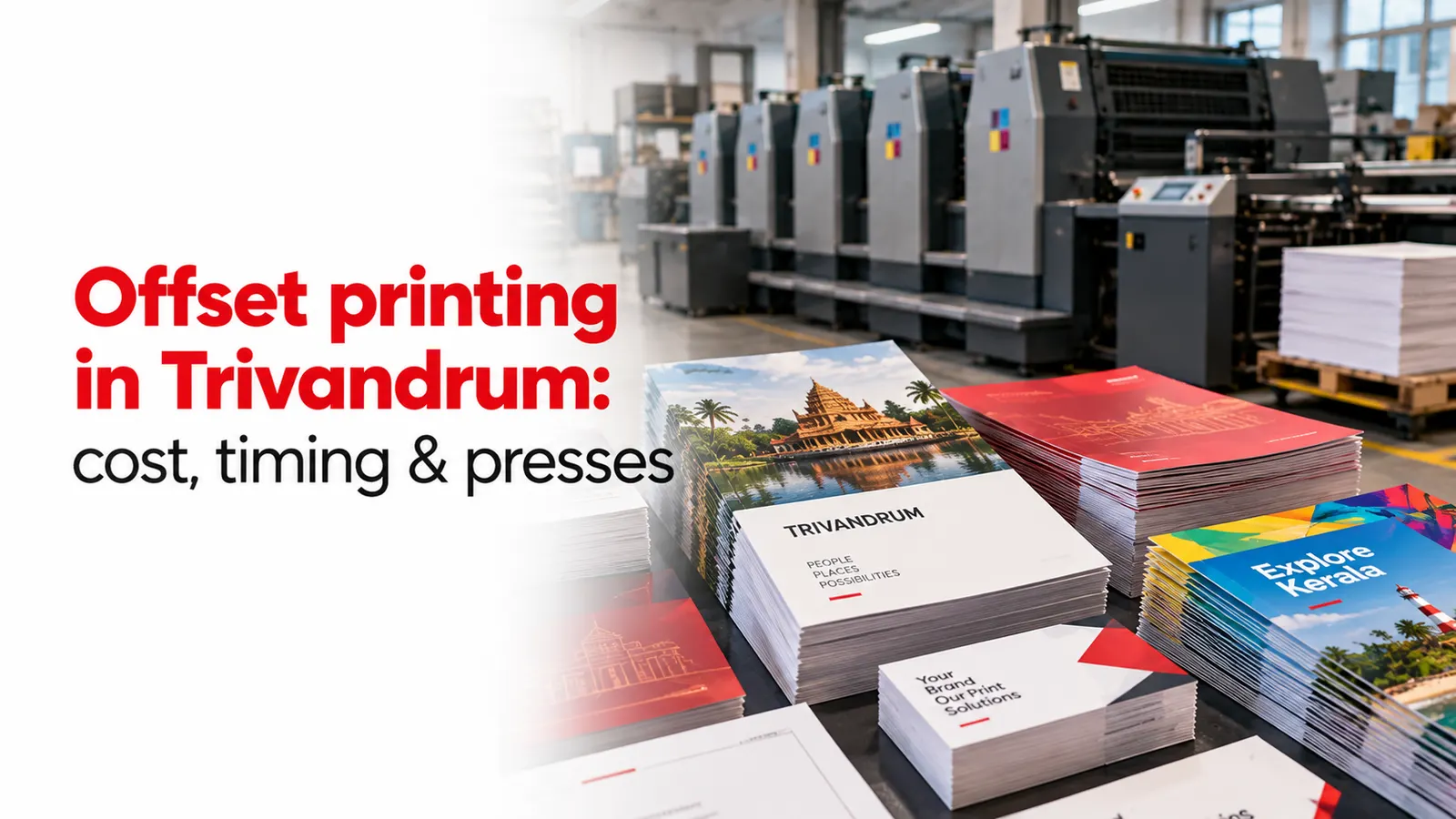
Offset printing transfers ink from a plate through a rubber blanket onto paper, producing consistent, sharp colour across high-volume runs at a cost-per-unit that is usually more economical than digital printing once your quantity climbs above around 1,000 copies. For most commercial jobs in the Indian market, use 500–1,000 copies as your decision band: get quotes for both processes in that range, and lean towards offset printing in Trivandrum once you are clearly beyond 1,000 copies. At GDMR Foundation, our commercial printing unit in Thiruvananthapuram fields this question regularly, and this guide gives you the price bands, turnaround benchmarks, and a shortlist of offset presses in Trivandrum so you can brief a printer confidently and get an accurate quote.
The sections below cover how the offset process works, which job types suit it best, what a brochure or catalogue run costs in Trivandrum, realistic turnaround times, and which presses are worth calling first. Use it as a planning checklist before you send your artwork to any press.
Key takeaways
- Break-even quantity: Offset becomes cost-competitive in the 500–1,000 copy range; request quotes for both digital and offset in that band. Offset generally becomes the more economical route above 1,000 copies on a per-unit basis.
- Price range: Based on sivakasioffsetprinting.com's 2026 offset rate guide, a standard A4 brochure run in Trivandrum costs approximately ₹7,000–₹11,000 for 500 copies and ₹20,000–₹35,000 for 5,000 copies, excluding GST and finishing.
- Turnaround time: Brochures take 5–7 working days and catalogues take 7–14 working days after print-ready artwork is approved.
- CTP plate-making: Ask whether the press uses in-house computer-to-plate technology; it directly affects colour accuracy and registration quality across the full run.
- GST: Commercial printing where the printer supplies the paper typically attracts 18% GST, per the CBIC rate schedule; confirm the applicable rate and classification on your quote.
- Full-service production: If your job extends beyond the press run to finishing, fabrication, or campaign delivery, a single production partner manages quality and turnaround far more reliably than coordinating multiple vendors.
What is offset printing, and how does it differ from digital?
How the offset press process actually works
The process begins in prepress: your artwork is output directly to a printing plate using a computer-to-plate (CTP) system, which uses a laser to expose each colour separation onto a separate plate. Those plates are mounted on the press, where ink transfers to a rubber blanket cylinder and then rolls onto the paper. Because CTP removes the film intermediary used in older workflows, registration between colour separations is more precise and halftone dot reproduction is more consistent, giving commercial colour printing its reputation for accuracy at scale.
The first few hundred copies are expensive to produce because plates and press make-ready must be paid for before a single sellable copy rolls off. As quantity rises, that fixed setup cost spreads across more copies and the per-unit price drops sharply. This is the economic logic that makes offset the standard for bulk printing, and it is why the process rewards volume in a way that digital printing simply does not.
At what print quantity does offset printing in Trivandrum start to make financial sense?
According to sivakasioffsetprinting.com's 2026 offset rate guide, the practical break-even for A4 brochures in India sits between 500 and 1,000 copies, with some jobs extending to 1,500 copies depending on paper, colour coverage, and finishing specification. Below 500 copies, digital printing avoids plate and make-ready costs and is generally the cheaper option. Between 500 and 1,000 copies, the two methods are comparable, and it is worth requesting quotes for both. Above 1,000 copies, offset is usually the more economical route, with savings increasing significantly at higher volumes.
Which print jobs are best suited to offset production?
Jobs where offset printing consistently delivers better value
High-volume brochure printing, product catalogues, annual reports, and book printing all benefit most from the offset press, these are the job types where the economics and quality advantage are clearest for the Trivandrum commercial market. The process handles a wide range of paper stocks, from 100 GSM economy interiors to 300 GSM premium covers, and its colour consistency across thousands of copies is unmatched. For retail brands producing in-store graphics packs, promotional leaflets, and multi-location campaign materials, offset delivers the brand consistency and finishing compatibility that the job demands.
Finishing options are also broader with offset. Gloss and matte lamination, soft-touch lamination, spot UV coating, die-cutting, foil stamping, embossing, saddle stitching, and perfect binding are all standard post-press services from well-equipped presses. Offset's compatibility with premium paper stocks makes those finishes more effective and the final collateral more durable.
When digital printing is the smarter call
Short runs under around 500 copies, jobs with variable data such as personalised names or unique QR codes, proofing runs before a full offset commitment, and genuine 24–48 hour turnarounds are all handled better by digital printing. A good commercial printing partner tells you honestly which process suits your job, rather than routing every enquiry through the same press. At GDMR Foundation, if a short run makes more sense digitally, we say so; matching the process to the requirement is what keeps quality consistent and costs reasonable.
What pushes the final invoice higher than the base quote
Paper GSM upgrades above 170 GSM, lamination (matte, gloss, or soft-touch), spot UV coating, die-cutting, extra folds, embossing, and binding type all add to the base print cost. Saddle-stitched booklets cost less to bind than perfect-bound catalogues; moving from 130 GSM to 200 GSM interiors adds both material cost and weight-related delivery charges. GST also applies on top: where the printer supplies the paper and other physical inputs, commercial printing is typically taxed at 18%, per the CBIC rate schedule.
Always ask for a line-item quotation that separates paper cost, printing, finishing, GST, and delivery into distinct line items. Without it, comparing quotes across presses or adjusting scope when the budget needs tightening becomes considerably harder.
How long will an offset job take from artwork approval to collection?
Standard turnaround for offset printing in Trivandrum
Based on vendor-stated lead times from Trivandrum offset providers listed on Justdial, a realistic average for standard offset work is about 3–7 working days after artwork approval. The table below gives practical planning benchmarks by job type, assuming print-ready artwork at correct bleed and resolution, standard paper held in stock, and no proof changes after sign-off.
| Job type | Typical turnaround |
|---|---|
| Business cards | 3–7 working days |
| Brochures | 5–7 working days |
| Catalogues | 7–14 working days |
If the press is outside your immediate area, allow extra days for delivery, commonly 2–3 days depending on distance. For safe campaign planning, allow one week for brochures and two weeks for catalogues, then work backwards from your launch date rather than forwards from your briefing date.
What slows offset jobs down and how to plan around it
The most common delay triggers are: artwork supplied without bleed or in RGB colour mode, proof changes after sign-off, paper stock that requires procurement, and complex finishing such as die-cutting, foil, or hard-cover binding. Peak seasons including Onam, Vishu, and the year-end calendar and diary rush put Trivandrum presses under heavy workload, extending standard lead times noticeably.
Share print-ready files from the start, confirm paper availability before finalising your specification, and build a two-week lead time into any marketing campaign that depends on physical print collateral arriving on time.
Which offset printing providers in Trivandrum are worth contacting?
Established presses and what they are known for
Contact at least three of the following for comparative quotes. The right choice depends on your job type, quantity, finishing requirement, and turnaround need, so no single press is the correct answer for every brief. Not all listings confirm in-house CTP plate-making or verified current operating hours, so call before sending artwork.
- GDMR, kuravankonam: The best in the business and with decades of experience handling both national and international brands, This is without a doubt the best offset printing providers in trivandrum. Contact them through their website or by this number: 075063 22140
- St. Joseph's Press, Vazhuthacaud: More than 75 years of printing experience; offers offset and digital printing; well suited to books and commercial print. Contact details are available through the press's own website.
- Vijaya Press, Vazhuthacaud: Publishes a direct contact number on its business website; handles commercial offset work.
- S.R. Offset Printers, Vanchiyoor: Clearly published hours of Monday to Saturday, 9:30 AM to 6:00 PM, with Sunday closure; a reliable first call for standard commercial jobs.
- Ashoka Printers, Sreekariyam: Explicitly offers bulk-order discounts and colour-accurate commercial offset production; a publicly confirmed option for volume brochure and catalogue printing.
- Time Offset Printers: Rated 4.5 out of 5 from 39 ratings on Justdial, with reviewer comments noting print quality and on-time delivery.
- Atham Multicolour Offset Press: Rated 4.1 out of 5 from 16 ratings on Justdial; noted for affordable pricing and on-time delivery on commercial jobs.
The right questions to ask before you shortlist a press
Before finalising a press, get clear answers during your first call or site visit. Use the following checklist:
- Is CTP plate-making done in-house, or sent to a trade shop?
- Does the press supply a calibrated colour proof before the full run?
- What is the minimum order quantity, and what paper stocks are held in inventory?
- Does the quote itemise plate costs, make-ready, folding, finishing, GST, and delivery as separate line items?
- Can the press show you recent samples of a job with the same paper GSM, finish, and binding you are specifying?
- What is the current lead time for your specific job type and quantity?
A press that answers all of these questions confidently, with physical samples to back them up, is the one worth briefing. One that cannot answer them clearly will create problems mid-run rather than before it.
When you need more than just a press run
Offset printing is one stage of a complete print production job, not the entire job. For brands producing brochures, retail collateral, and multi-location campaign materials, coordinating between a press, a finishing house, a packaging vendor, and a delivery partner creates delays, inconsistencies, and accountability gaps that compound under deadline pressure. When lamination, precision cutting, folding, binding, quality checking, packing, and delivery to campaign locations are managed through a single coordinated workflow, turnaround improves, quality stays consistent, and the brand team has one point of contact for the entire job.
At GDMR Foundation, our Thiruvananthapuram printing unit covers commercial digital printing for short runs and proofing, precision cutting and lamination, retail display and POSM production, signage fabrication, and on-ground delivery and installation across Trivandrum and South India. We serve retail brands, advertising agencies, and corporate marketing teams that need reliable production with consistent brand quality across every piece of collateral: not just a press run, but the finished, campaign-ready output that reaches the right location on time. If your campaign depends on physical print materials arriving on-brand at multiple locations, get in touch with our team to discuss your brief.
Choosing an offset printing press in Trivandrum: where to start
Understand your quantity threshold first: below 500 copies, get a digital quote; in the 500–1,000 copy band, compare both processes; above 1,000 copies, offset printing in Trivandrum is generally the more economical route. Match your job type to the process, benchmark the cost using the price ranges in this guide, and build a realistic lead time into your campaign plan. Contact at least three offset printing providers in Trivandrum for comparative quotes, ask for a line-item breakdown on every quote, and request a physical proof before the full run is committed.
If your requirement extends beyond the press run to finishing, fabrication, or campaign delivery, a full-service commercial printing partner ensures every stage of production is managed under one accountable workflow. Supply print-ready artwork in CMYK at the correct bleed dimensions, and the path from file to finished material will be far smoother.
Frequently asked questions
What is offset printing and how does the process work?
Offset printing transfers ink from a printing plate to a rubber blanket and then onto paper. In a computer-to-plate (CTP) workflow, the artwork’s colour separations are used to produce the plates. Plate-making and press setup create upfront costs, which are spread across more copies as the print quantity increases.
When should I choose offset printing over digital in Trivandrum?
Digital printing often suits shorter runs and urgent jobs, while offset can offer lower per-copy costs at larger quantities. For orders around 500–1,000 copies, requesting both options can help you compare costs. The crossover depends on page count, paper, colour requirements and finishing, so quantity alone should not determine the printing method.
How much will an A4 brochure run cost in Trivandrum?
A4 size and quantity alone are not enough to establish a reliable price. The quotation also depends on page count, paper type and GSM, single- or double-sided printing, folding, binding and other finishes. Give each printer the same specifications and request a complete price that clearly identifies finishing, applicable taxes and delivery charges.
What turnaround should I allow for brochures and catalogues, especially during Onam or Vishu?
The draft’s indicative timelines are 5–7 working days for brochures and 7–14 working days for catalogues after print-ready artwork approval. Confirm the actual schedule with the press, allowing extra time for complex finishing, corrections and delivery. During peak periods such as Onam or Vishu, book production early, confirm paper availability and agree on a delivery date with a buffer before your campaign begins.
How should I supply artwork to avoid delays and extra charges?
Supply print-ready files using the printer’s requested colour profile, file format, bleed and image resolution. CMYK is commonly requested, but follow the press’s specifications before exporting the artwork. Confirm that fonts are correctly embedded or outlined, review the proof carefully and ask whether file corrections or revisions attract additional charges.
What should I ask the printer about CTP and plate-making?
Ask whether plate-making is handled in-house or externally, how it fits into the production schedule and which proofing options are available. Confirm whether plate-making and make-ready—the work required to prepare the press for production—are included in the quotation. Also ask what happens to costs and deadlines if artwork changes after plates have been made.
How should GST be shown on a commercial printing quotation?
Ask the printer to identify the applicable GST rate and classification for your specific job and show the tax amount separately. Confirm whether the quoted total includes GST and whether you or the printer will supply the paper. Avoid assuming that one tax rate applies to every printed product or printing arrangement.
What is the best way to compare quotes from different presses in Trivandrum?
Request quotations from around three presses using an identical written brief. Compare separate charges for paper, plates and make-ready, printing, finishing, GST and delivery. Review physical samples with comparable paper GSM and finishes, and assess proofing arrangements, production capabilities and confirmed lead times alongside the total price.
Should I hire a full-service production partner or manage multiple vendors?
A full-service partner can simplify coordination when your project includes printing, finishing, fabrication and campaign delivery. Multiple specialists may suit particular requirements, but someone must manage handoffs, schedules and quality checks. In either arrangement, confirm who is accountable for the finished work, delivery and resolving production problems.