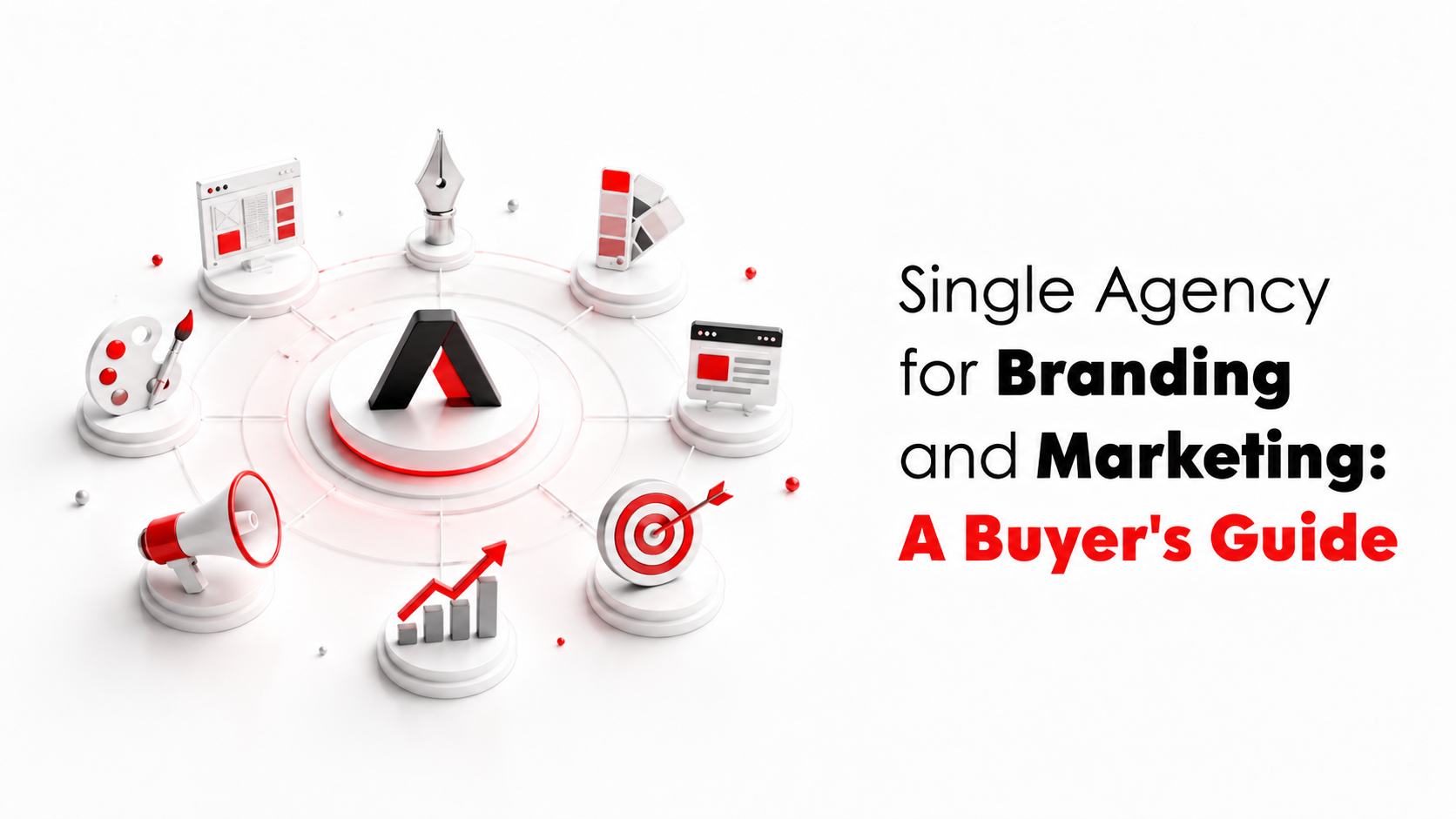
Single Agency for Branding and Marketing: A Buyer’s Guide
Three agencies, five WhatsApp threads, and a logo that looks slightly different on every channel you own. If that sounds familiar, the problem isn't your vendors' individual quality. It's the structural gap between them. Fragmented vendor relationships produce fragmented brands, and no amount of creative talent fixes a coordination problem.
Choosing a single agency for branding and marketing solves this at the root. Agencies like GDMR Foundation, a multi-disciplinary outfit based in Thiruvananthapuram covering brand strategy, digital marketing, large-format printing, signage fabrication, and full campaign execution under one workflow, show what this model looks like in practice. This guide gives you a clear framework to decide whether the single agency model for branding and marketing is right for your business, evaluate candidates honestly, and build a shortlist you can actually act on.
The coordination problem that's quietly draining your brand
When your brand starts contradicting itself
When you work with separate vendors for identity, digital, and print, each team works from their own interpretation of your brief. The website designer references the brand deck from six months ago. The print vendor uses the hex code they saved from the last job. The social media agency adapts the tone to what performs, not what was agreed. Over time, you end up with slightly different brand colours across channels, inconsistent messaging between your ads and your brochures, and a visual identity that drifts further from itself with every new execution.
Brand inconsistency isn't a design problem. It's a coordination problem. No individual vendor is necessarily doing poor work; the failure is in the handoffs between them.
The hidden overhead nobody budgets for
Separate onboarding sessions, duplicate briefings, time spent reconciling conflicting vendor outputs, chasing three different timelines simultaneously. None of this appears in any agency invoice, but all of it costs real hours. In practice, marketing leads often report spending 20 to 30 per cent of their bandwidth on vendor management rather than strategy. That's the real productivity loss, and it compounds every campaign cycle.
A genuinely integrated agency eliminates this overhead structurally. One brief, one account lead, one production timeline, one point of accountability. That compression alone returns meaningful hours to your marketing function every quarter.
Why hire a single agency for branding and marketing
More than a logo and a social media calendar
A true full-service brand and marketing agency covers brand strategy, visual identity, digital marketing, content, paid media, and performance analytics as an interconnected system. The critical distinction is that the same team which builds the brand system also activates it across channels. Strategy doesn't get lost in translation between a brand consultant, a creative studio, and a digital agency that never spoke to each other.
The agency's job is to carry the same insight from positioning through to a performance campaign brief, so the paid ad that drives a click and the store signage that closes the sale are saying the same thing in the same voice. That's the core promise of one-stop marketing agency thinking, and it's why the model has gained traction across India's mid-market and enterprise segments alike.
Where physical touchpoints complete the picture
Most Indian businesses underestimate scope when they think about integrated partnerships. A genuine end-to-end brand and marketing agency also covers print production, signage, retail display, in-store branding, and campaign installation, not as add-ons, but as core deliverables. GDMR Foundation's production unit in Thiruvananthapuram handles large-format printing, UV printing on rigid and specialty substrates, signage fabrication, precision cutting, POSM production, and on-ground campaign rollout across multiple locations, all within one integrated workflow.
That consolidated capability is how brands operating at scale maintain consistency from their digital campaigns through to their store environments. For retail brands, FMCG businesses, and companies running multi-city campaign activations, physical and digital touchpoints must be managed by the same partner. Otherwise, your store looks like one brand and your Instagram looks like another.
The honest trade-offs before you commit
Where single-agency models genuinely deliver
Faster execution, one point of accountability, aligned messaging, and lower coordination overhead are the four advantages that consistently emerge in client-side assessments of consolidated agency models. Integrated agencies can also be more cost-efficient than separate vendors: bundling scope reduces onboarding duplication and removes the management load of reconciling conflicting outputs. When brand strategy directly informs campaign creative, performance metrics tend to improve because the message is consistent all the way through the funnel.
The risks worth knowing upfront
Single point of failure is the most serious risk: if the agency underperforms, you lose across both brand and marketing simultaneously, and switching mid-engagement is genuinely disruptive. Skill gaps are also real; the strongest integrated agencies are transparent about where they bring in specialists rather than pretending to be equally excellent at every discipline. Less obvious but equally real is the risk of reduced outside perspective, since separate specialists sometimes surface sharper ideas than a single team operating in its own rhythm.
Mitigate these through contract structure. Build in a 90-day performance review threshold, clear deliverable ownership in writing, defined KPIs by phase, and a reasonable notice period for exit. You keep the integration benefit without surrendering oversight.
How to evaluate a single agency for branding and marketing
The four criteria that actually predict performance
Strategic depth is your first filter. Does the agency start with a business problem or jump straight to deliverables? Strong agencies produce research-led positioning before visuals or tactics. Proof of integration is the next test: can they show case studies where brand strategy directly shaped campaign creative and produced measurable outcomes? Ask specifically for documented examples, growth in brand recall, qualified lead volume, or channel consistency metrics, that demonstrate what credible integrated proof looks like in practice.
Team composition matters more than agency size. Are there named senior strategists, brand designers, and performance media specialists, or is there one generalist team with no depth? Finally, test cross-channel consistency by reviewing portfolio samples across digital, print, and retail. Strong agencies hold up across all three; weaker ones are impressive only in one medium.
Discovery questions to ask in your first agency meeting
Bring these into every evaluation conversation. They separate partners from vendors faster than any credentials document:
- What business problem are you solving first, and how does that inform both brand strategy and marketing?
- Can you show us a case where research changed the brand direction or campaign outcome?
- Who exactly works on the account, and who leads brand strategy versus performance?
- How do you turn brand positioning into media briefs, landing pages, and paid campaigns?
- How do you measure success for brand work separately from performance marketing?
- What does your reporting look like, and how often do you review and optimise?
An agency that answers these questions clearly, with examples, has a process. One that deflects or goes straight to portfolio is telling you something important.
What to budget and what to measure in India
India pricing benchmarks by business stage
Pricing is driven by scope, not just company size. A startup typically pays ₹25,000 to ₹1.5 lakh for a branding project and ₹15,000 to ₹90,000 per month on a marketing retainer. Growing SMEs usually see branding fees between ₹1.5 lakh and ₹6 lakh, with retainers ranging from ₹50,000 to ₹2 lakh per month. Enterprise programmes and rebrands start at ₹20 lakh and can exceed ₹50 lakh, with marketing retainers running ₹1.5 lakh to ₹10 lakh-plus monthly.
Scope is the real driver. The moment you add brand research, naming, identity systems, guidelines documentation, paid media management, content production, and ongoing optimisation, the retainer climbs regardless of company size. Treat any quote that seems unusually low as a signal to check what is excluded before signing.
KPIs by phase: what good looks like at 3, 6, and 12 months
In the first three months, expect leading indicators only: brand consistency in production, tracking accuracy, branded search baseline, impressions, reach, and engagement. No commercial claims are realistic yet. Between months three and six, early lift should appear in branded search volume, direct traffic, conversion rate, cost per lead, and qualified lead volume. By the 12-month mark, commercial impact becomes visible: CAC to LTV improvement, repeat purchase rate, ROAS, referral rate, and revenue from branded demand channels.
Brand metrics move slower than performance metrics. Any agency promising significant awareness results in month one is overstating what the timeline actually allows. Set your expectations by phase, and hold the agency to leading indicators first.
Building a shortlist of five: red flags and a scoring method
Red flags that signal trouble ahead
Walk away from any agency that cannot name who specifically will work on your account, presents a portfolio of creative samples with no measurable outcomes attached, or delivers a vague proposal without clear ownership of deliverables. Suspiciously low pricing without an explanation of what is excluded is a contract problem waiting to happen. And if there is no defined process connecting discovery, brand strategy approval, and campaign activation, the integration you're paying for doesn't actually exist.
A simple scoring framework for your final five
Score each shortlisted agency across six weighted criteria: strategic thinking, relevant portfolio proof, team composition, cross-channel execution capability, pricing transparency, and communication quality. Assign a 1 to 5 score per criterion per agency. The total produces a defensible ranking you can present internally without second-guessing yourself.
The highest scorer isn't always the right answer. Weight the criteria that matter most for your specific model: a retail brand running multi-city campaign rollouts should weight cross-channel execution and physical production capability more heavily than a digital-only business would. The framework gives you structure; your context gives it the right weighting.
Make the decision that removes coordination permanently
Fragmented vendors produce fragmented brands. Working with a single agency for branding and marketing solves this at the structural level, not just in the first project. For brands that need one partner covering identity, digital marketing, print production, signage, retail display, and campaign execution across India, a genuine single-vendor branding services model, the consolidated approach isn't just a convenience. It's a strategic advantage that compounds with every campaign you run.
GDMR Foundation's end-to-end production and execution capability, built specifically for retail brands, agencies, corporate teams, and multi-location businesses, is worth including in your evaluation shortlist. The decision is only as good as the process behind it: use the criteria above, ask the discovery questions, and set realistic KPI expectations by phase before committing to any retainer.
Start with your shortlist of five, apply the scoring framework, and book discovery calls before signing anything. The right partner is out there; this guide gives you the tools to find them.
FAQs:
Q: What is a single agency for branding and marketing?
A: A single agency is a full-service partner that handles brand strategy, visual identity, digital marketing, content, paid media and performance analytics, and also executes physical production and rollouts under one workflow. The article cites GDMR Foundation in Thiruvananthapuram as an example of this integrated model.
Q: How does a single agency stop my brand from drifting across channels?
A: By keeping strategy and activation within the same team, a single agency carries the same insight from positioning through to campaign execution, preventing handoffs that create inconsistent colours, messaging and tone. That unified ownership reduces the interpretation gaps that cause brand drift.
Q: What hidden overheads do multiple vendors create?
A: Multiple vendors generate separate onboarding sessions, duplicate briefings, time spent reconciling conflicting outputs and managing several timelines. Marketing leads often report spending 20–30% of their bandwidth on vendor management rather than strategy, according to the article.
Q: Which services should a genuine end-to-end brand and marketing agency provide?
A: Expect integrated offerings including brand strategy, visual identity, digital marketing, content, paid media and performance analytics, plus print production, signage, retail display, in-store branding and campaign installation. The article highlights capabilities like large-format printing, UV printing on specialty substrates, signage fabrication, precision cutting and POSM production as core deliverables.
Q: How do I know if the single-agency model is right for my business?
A: If you’re losing time to vendor coordination or seeing inconsistent identity across digital and physical touchpoints, a single agency can be worth it because it consolidates briefings and accountability. The model is noted in the article as gaining traction across India's mid-market and enterprise segments for those exact reasons.
Q: What should I check when evaluating single-agency candidates?
A: Look for evidence of an integrated workflow, one point of accountability (one brief/account lead), and in-house or tightly coordinated production capabilities so strategy flows through to physical execution. Case studies or examples of end-to-end rollouts—like the GDMR Foundation example—are useful proof points.
Q: Will hiring one agency actually save money?
A: A single agency may not always lower individual invoices, but it reduces hidden productivity costs by cutting down vendor management and duplicate processes. That compression—one brief, one timeline, one lead—typically returns meaningful hours to your marketing function each quarter.

Leave a comment: