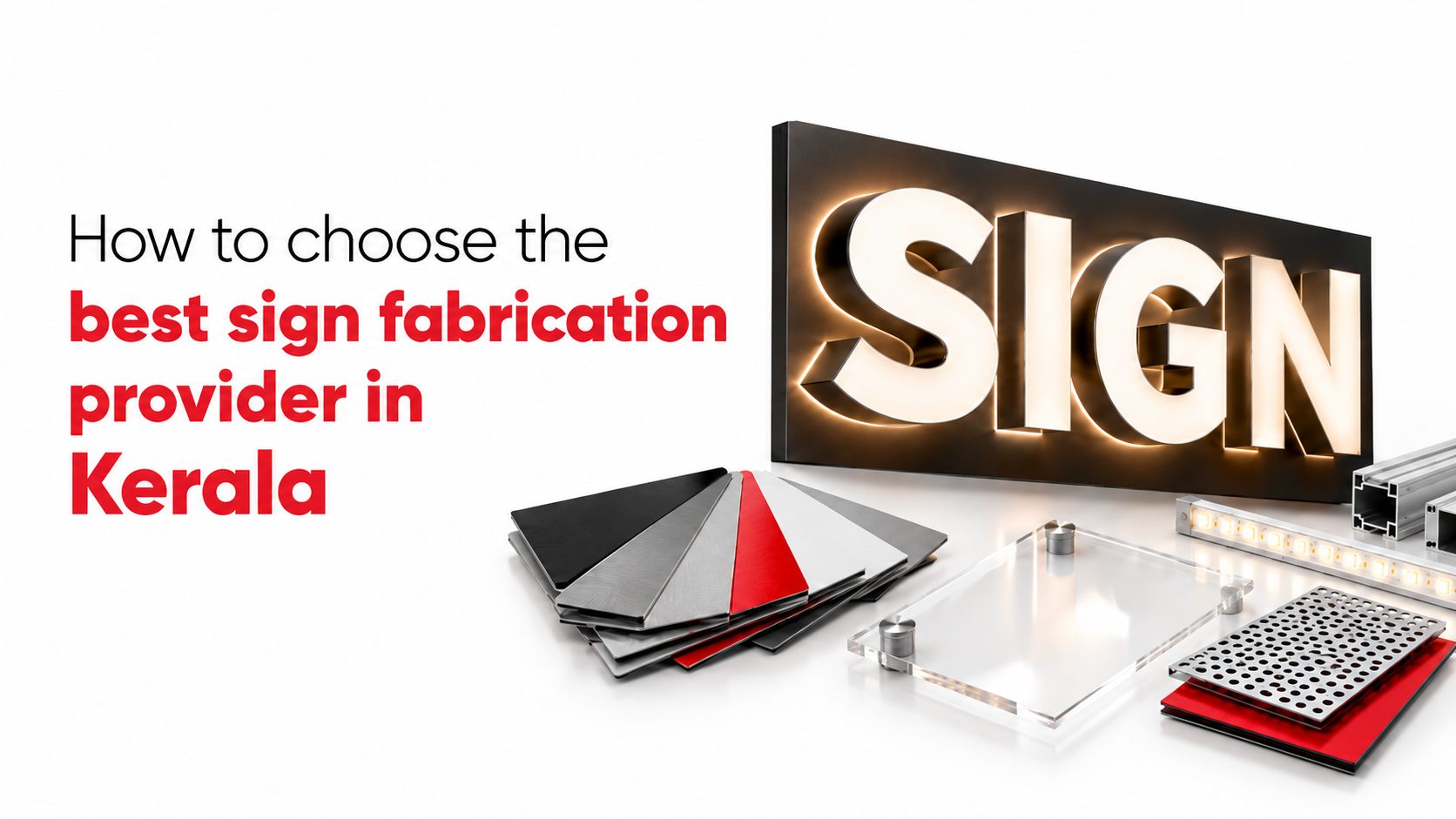
How to choose the best sign fabrication provider in kerala
If you are asking what is the best sign fabrication provider in Kerala, you are probably not short of options, walk through any commercial street in Thrissur, Kozhikode, or Kochi and you will find vendors who will quote you a price within minutes. The harder task is finding a fabricator who can actually produce, finish, and install a sign to a professional standard. Such a sign holds up through the monsoon, looks sharp at close range, and does not need urgent repairs six months later.
This guide is not a directory. It is an evaluation framework you can use whether you need a single shop board in Thiruvananthapuram or a multi-location signage rollout across Kerala. Throughout, we reference what integrated fabrication looks like at a full-capability setup, using GDMR Foundation's Thiruvananthapuram-based print and signage production unit as a working benchmark. By the time you finish reading, you will know exactly what to look for, what to ask, and how to compare sign fabricators in Kerala on equal terms.
1. What fabrication capabilities reveal about a provider's range
Why material breadth signals production maturity
A vendor's material range is one of the clearest indicators of their workshop depth. A provider limited to flex banners and basic acrylic boards is not equipped to handle complex retail signage, 3D channel letters, or ACP cladding. A serious signboard fabrication Kerala provider should work confidently across acrylic in multiple grades, 4mm ACP panels, PVC board, aluminium, foam board, and rigid substrates suited to direct UV printing.
A full-capability setup, like the production unit at GDMR Foundation, covers all of these materials through a single integrated workflow. That breadth matters because retail campaigns and commercial fit-outs rarely require just one sign type. When your fabricator handles diverse materials in-house, you get tighter quality control and faster turnaround without managing multiple vendors simultaneously.
Fabrication processes worth asking about
Not every vendor who sells signs actually fabricates them. Many outsource cutting, routing, and finishing to third parties, which adds time and cost while introducing quality inconsistency. Ask specifically whether CNC routing, laser cutting, and contour cutting are done in-house. Edge sharpness on acrylic letters and the precision of aluminium channel returns depend entirely on these processes being controlled by the fabricator directly.
For illuminated signs, the fabrication discipline extends further. LED module integration, wiring quality, and transformer selection determine whether a backlit sign performs reliably for years or starts failing within months. 3D channel letters, backlit acrylic faces, and LED sign components require consistent internal fabrication standards that a reseller or basic print shop cannot match. Any reputable LED signboard maker in Kerala should be able to demonstrate that these processes happen on their premises, before you commit, ask directly.
2. Best sign fabrication provider in Kerala: evaluating materials for the local climate
ACP and aluminium for long-term outdoor durability
Kerala's combination of coastal salt air, persistent humidity, and heavy monsoon rainfall is demanding on outdoor signage in ways that inland conditions are not. PVDF-coated 4mm ACP consistently outperforms other base materials here. It resists UV fading, handles moisture well, and maintains colour stability under tropical sun. Quality ACP installations in Kerala typically last 8 to 12 years with reasonable maintenance.
Anodised aluminium is the right choice when you need a metallic finish or when the installation is within a few kilometres of the sea. Coastal-grade anodising provides excellent corrosion resistance because the protective layer is integral to the metal rather than applied as a coating. Expect lifespans of 10 to 15 years for properly specified aluminium signage in coastal installations. Avoid untreated mild steel or thin acrylic bodies as the primary structure for outdoor signs; vendors sometimes push these for cost reasons, and they degrade quickly in Kerala's conditions.
LED modules and acrylic grades: what to specify
For outdoor and semi-outdoor illuminated signs, IP-rated LED modules are non-negotiable. The IP rating indicates the module's resistance to moisture ingress, and in Kerala's climate, an unrated or low-rated module will fail prematurely regardless of how good the rest of the fabrication is. Ask every vendor for the IP rating, the LED brand, and the driver warranty before you discuss pricing.
Driver and transformer quality matters as much as the LED strips themselves. A quality LED module rated at 50,000 hours will underperform if it is paired with a cheap driver that fails in year one. For acrylic sign faces, specify UV-treated grades. Standard acrylic yellows and hazes under prolonged sun exposure; UV-stabilised grades maintain clarity significantly longer, which preserves the illuminated appearance of glow signs and channel letters over time.
3. How to evaluate workmanship, finishing, and installation support
Reading a portfolio and site visit like a professional
Photographs of signs are easy to curate. What photographs cannot show you is how a sign holds up under real outdoor conditions after six months of rain and sun. Request the addresses of completed installations and visit at least one in person. Look at edge finishing on acrylic letters, weld quality on metal returns, paint consistency on ACP panels, and the evenness of LED spacing inside channel letters. These details separate professional custom sign fabrication Kerala clients can rely on from production that looks acceptable only in a controlled showroom environment.
Reputable fabricators maintain a portfolio of installed work that clients can physically inspect. GDMR Foundation, for example, has executed retail branding and signage installations for clients across Kerala and South India, including major retail names. That kind of verifiable track record is a standard any serious vendor should be able to meet. If a vendor cannot point you to an installed sign you can inspect in person, treat that as a significant gap.
Installation capability and permit guidance
A fabricator who cannot install is only half the solution. Proper installation for outdoor signage Kerala projects includes structural fixing, weatherproofing all joints and penetrations, electrical connection and testing for illuminated signs, and safe access planning for elevated installations. If the vendor outsources installation, find out who actually does it and whether the subcontractor carries appropriate insurance and public liability cover. The quality of the installation directly affects how long the fabrication investment lasts.
Kerala's municipalities require written permission from the municipal Secretary before any external advertisement or sign is erected. This applies across Kochi, Thiruvananthapuram, Kozhikode, Thrissur, and other municipal areas, and enforcement has become increasingly active, with unauthorised boards liable for removal and fines. A reliable fabrication partner will guide you through the permit process rather than treating it as your problem alone. Ask prospective vendors directly whether they assist with documentation; those experienced with Kerala's permit requirements will answer confidently.
4. Best sign fabrication provider in Kerala: understanding pricing and costs
Benchmark price ranges by sign type
Sign pricing in Kerala varies significantly based on fabrication complexity, material grade, LED specification, and whether installation is included. The ranges below are indicative for 2026 and should be used as a calibration tool when reviewing quotes, not as fixed market prices.
- Basic acrylic shop signs - ₹250 - ₹500 per sq ft
- Premium Acrylic or ACP shop signs - ₹500 to ₹1,500 and above per sq ft
- LED Channel Letters and 3D letters - ₹500 - ₹900 per sq ft
- Premium metal or PVD channel letters - ₹850 - ₹1600 per sq ft
- Light Box or Glow Sign - ₹250 - ₹500 per sq ft
A quote that comes in well below these ranges deserves scrutiny, not celebration. The gap usually means a compromise somewhere: thinner acrylic, lower-grade LED modules, unrated drivers, or outsourced installation. Understanding what is behind the number is more useful than comparing the numbers themselves. This is particularly relevant for hoarding fabricators in Kerala, where structural and installation costs can easily be obscured inside a single bundled figure.
How to request and compare quotes fairly
A bundled quote that gives you a single total figure tells you almost nothing useful. Request itemised quotes from every vendor covering material specification and grade, fabrication labour, LED module and driver details, mounting hardware, installation, design charges if applicable, transport, and any permit assistance. This structure makes it possible to compare shop sign fabricators in Kochi, Thiruvananthapuram, or anywhere else in the state on the same basis.
For a genuinely fair comparison, specify the same parameters to every vendor: the same material grade, the same LED IP rating, and the same square footage. If vendor A quotes PVDF-coated ACP with IP65-rated modules and vendor B quotes a generic acrylic board with unrated LEDs, the price difference reflects a real quality difference, not vendor efficiency. A prompt worth using when approaching vendors: "Please quote against this specification sheet" rather than "What would this cost?"
5. Warranty, maintenance, and after-sales: what reputable fabricators commit to
Warranty terms to expect and what they should cover
Reputable Indian sign fabricators typically offer workmanship and materials warranties of 1 to 5 years. LED-specific coverage is usually tied to the module manufacturer's rating, with quality modules commonly rated at 50,000 hours. For premium outdoor signs, a structural or finish warranty of 3 to 5 years is a reasonable expectation. Anything shorter than 12 months on workmanship, or with no written terms at all, should raise questions.
Get warranty terms in writing before the order is confirmed. Review what is explicitly excluded; physical damage and power surges beyond the supplied driver are common exclusions across the industry, but some vendors write exclusions broadly enough to avoid almost any warranty obligation. A warranty document that is specific about what it covers and what it does not is a better sign than a verbal promise of "we'll take care of it."
Maintenance support and spare-part access
After-sales support is often overlooked during the selection process and only becomes important when something fails. A good fabricator retains the original production specification and drawings, holds or can source replacement LED modules and drivers of the same specification, and has a clear process for handling repair requests. Ask directly: "If an LED module fails in year two, how do I get it replaced, and at what cost?" The answer reveals a great deal about how seriously the vendor takes the post-installation relationship.
For larger illuminated or complex installations, negotiating an annual maintenance contract is a practical step worth considering. Regular inspection of LED connections is best treated as a separate task, schedule it independently from general cleaning of sign faces and checks on mounting hardware, as each requires different attention. Taken together, these measures extend sign life considerably in Kerala's climate. Some fabricators include one inspection visit in the first year as standard; others offer formal maintenance programmes at an agreed rate. Either way, knowing your options before you sign the order gives you better leverage than asking afterwards.
Choosing with confidence: the five filters that matter
Identifying what is the best sign fabrication provider in Kerala comes down to more than price or proximity. The right provider handles your requirements from design-ready files through to installed and signed-off signage without requiring you to coordinate multiple vendors, chase permits independently, or wonder who is responsible when something goes wrong.
The five filters covered here form a coherent evaluation checklist. Consider each in turn: fabrication capability and material range; climate-appropriate material specification; workmanship and installation quality; transparent, itemised pricing; and written warranty commitments with clear after-sales support. Integrated providers like GDMR Foundation, which manages the full production and installation workflow from their Thiruvananthapuram facility, serving clients across Kerala and South India, offer the kind of single-point accountability that reduces project risk and protects brand consistency at every stage.
Use these criteria as your shortlist guide. Identify two or three sign fabricators in Kerala who pass all five filters, request itemised quotes on the same specification from each, visit at least one completed installation per vendor, and make your decision from that structured comparison. Following these filters consistently will help you determine what is the best sign fabrication provider in Kerala for your specific project. Reach out to the GDMR Foundation team to discuss your signage brief and understand how they approach fabrication, installation, and after-sales as an integrated commitment.
FAQs:
Q: How do I choose the best sign fabrication provider in Kerala?
A: Use an evaluation framework that checks material breadth, in-house fabrication processes, experience with local climate conditions, and capacity for multi-location rollouts. Compare vendors on whether they handle acrylic, 4mm ACP, PVC, aluminium and rigid UV-print substrates in-house, and use a full-capability setup like GDMR Foundation's Thiruvananthapuram unit as a benchmark.
Q: What materials work best for outdoor signs in Kerala's monsoon and coastal conditions?
A: PVDF-coated 4mm ACP is the recommended choice for Kerala because it resists UV fading, handles moisture, and maintains colour stability; quality ACP installations typically last 8–12 years. For metallic finishes and coastal sites choose anodised aluminium with coastal-grade anodising, which can last roughly 10–15 years; avoid untreated mild steel or very thin acrylic for long-term outdoor use.
Q: How can I tell if a sign company actually fabricates signs in-house or just resells them?
A: Ask directly whether CNC routing, laser cutting and contour cutting happen on their premises and request photos or a visit to their production unit. Vendors who outsource cutting and finishing add time and inconsistency, so insist on proof of internal fabrication for critical processes and illuminated sign assembly.
Q: What should I ask a fabricator about illuminated and LED signage to ensure reliability?
A: Ask how LED modules are integrated, what wiring standards and transformer types they use, and whether LED components and 3D channel letters are assembled on site. These details determine whether a backlit sign will perform reliably for years or begin failing within months, so request examples of previous installations and maintenance records if available.
Q: Is it better to hire a specialist or an integrated provider for a retail fit-out or multi-location signage rollout?
A: An integrated provider that handles diverse materials and processes in-house is usually better for retail fit-outs and multi-location rollouts because it gives tighter quality control and faster turnaround. A basic print shop or reseller may suffice for a single shop board, but for consistent results across many sites choose a full-capability fabricator.
Q: Why does a fabricator's material range indicate production maturity?
A: A broad material range—acrylic in multiple grades, ACP, PVC board, aluminium, foam board and rigid UV-print substrates—shows workshop depth and the ability to handle complex signage types like 3D channel letters and ACP cladding. Providers limited to flex or basic acrylic are less likely to meet higher technical and finish standards required for commercial projects.
Q: Which fabrication processes most affect finish quality on acrylic letters and aluminium channel returns?
A: CNC routing, laser cutting and contour cutting are the critical processes that determine edge sharpness and precision of aluminium returns. If these operations are outsourced rather than controlled in-house, you risk inconsistent edges and lower overall finish quality.

Leave a comment: